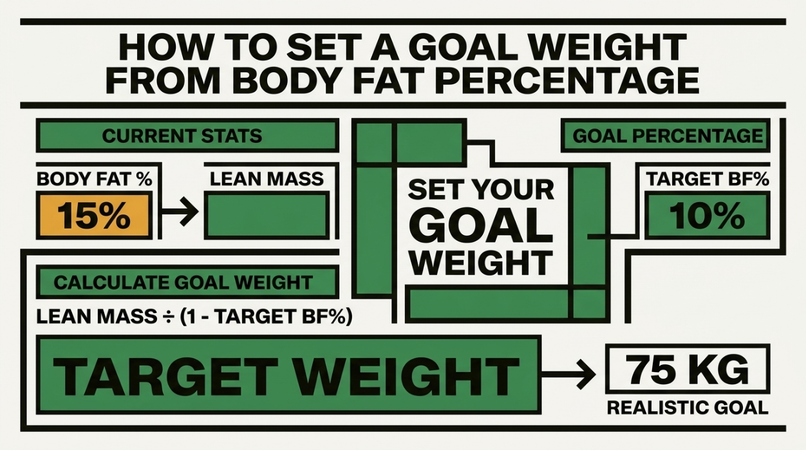
Short answer: setting a goal weight from a body fat target is more useful than picking a round number, because it starts from the part of you that you want to keep. Work out your lean body mass, divide it by one minus your target body fat as a decimal, and that is your goal weight, assuming you hold onto the lean mass.
The arithmetic
Your bodyweight is lean mass plus fat mass. Lean mass is everything that is not fat: muscle, bone, organs, water. When you diet properly, lean mass stays roughly constant and fat mass falls.
Step 1. Lean mass = current weight x (1 – current body fat / 100)
Step 2. Goal weight = lean mass / (1 – target body fat / 100)
Worked example, 85 kg at 25 percent body fat, targeting 15 percent:
- Lean mass = 85 x 0.75 = 63.75 kg
- Goal weight = 63.75 / 0.85 = 75 kg
- Fat to lose = 10 kg
What this reveals that a scale target hides
| Person at 85 kg | Body fat | Lean mass | Weight at 15% BF |
|---|---|---|---|
| Trained | 18% | 69.7 kg | 82 kg |
| Average | 25% | 63.8 kg | 75 kg |
| Untrained | 32% | 57.8 kg | 68 kg |
Three people at the same starting weight, aiming at the same body fat percentage, arrive at goal weights fourteen kilograms apart. A shared target of eighty kilograms would be trivially easy for one and impossible without losing muscle for another. This is why generic goal weights mislead.
Choosing a realistic target
| Category | Men | Women | Sustainability |
|---|---|---|---|
| Essential fat | 2-5% | 10-13% | Not sustainable |
| Competition lean | 6-9% | 14-17% | Short phases only |
| Lean and maintainable | 10-15% | 18-24% | Realistic long term |
| Average | 18-24% | 25-31% | Comfortable |
For women in particular, very low body fat can disrupt menstrual function and bone health. The lean and maintainable row is where most people should aim if the goal is to stay there rather than peak for a photograph.
The assumption that decides whether it works
Every calculation above assumes your lean mass stays constant. That is achievable and it is not automatic. It requires two things throughout the deficit:
- Protein at 1.6 to 2.2 g per kg of bodyweight daily. Calculate yours.
- Resistance training at least twice weekly. Protein supplies material; training supplies the reason to keep it.
Without both, some of what you lose is muscle. Your actual goal weight then comes in lower than calculated, and you arrive leaner on paper but smaller and softer in appearance. That outcome is the reason people hit a target weight and feel disappointed.
Measuring body fat well enough
The whole calculation rests on your starting body fat figure. A four percentage point error moves the goal weight by roughly three kilograms.
- DEXA: 1 to 2 percent error, needs a clinic visit.
- Tape method: 3 to 4 percent, free and repeatable. Navy method calculator.
- Bioimpedance scale: 4 to 8 percent, heavily affected by hydration.
Use the same method throughout. Consistency matters more than absolute accuracy, because what you are tracking is the change.
How long it takes
At a sustainable 0.5 kg per week, ten kilograms of fat takes about twenty weeks. Faster is possible at higher starting body fat and increasingly costly as you get leaner. Past roughly one percent of bodyweight per week, a larger share of the loss comes from lean tissue, which directly undermines the assumption the whole calculation rests on.
FAQ
How do I calculate my goal weight from body fat?
Lean mass divided by one minus your target body fat as a decimal. At 63.75 kg lean mass and a 15 percent target, that is 63.75 / 0.85 = 75 kg.
What body fat percentage should I aim for?
10 to 15 percent for men and 18 to 24 percent for women is lean and maintainable. Lower is achievable but harder to sustain.
Why is my calculated goal weight higher than I expected?
Because you carry more lean mass than you assumed. That is a good position to be in.
What if I lose muscle along the way?
Your goal weight drops and you arrive smaller than intended. Protein and resistance training are what prevent it.
Sources
- Gallagher D et al. Healthy percentage body fat ranges: an approach for developing guidelines based on body mass index. American Journal of Clinical Nutrition, 2000.
- Helms ER, Aragon AA, Fitschen PJ. Evidence-based recommendations for natural bodybuilding contest preparation: nutrition and supplementation. JISSN, 2014.
- Garthe I et al. Effect of two different weight-loss rates on body composition and strength in elite athletes. IJSNEM, 2011.
- Hodgdon JA, Beckett MB. Prediction of percent body fat from body circumferences and height. Naval Health Research Center, 1984.
General information, not medical advice. Very low body fat carries health risks, particularly for women.
GramGoal Team. We build nutrition calculators and price-check the supplement market monthly. General information, not medical advice. See our methodology and affiliate disclosure.