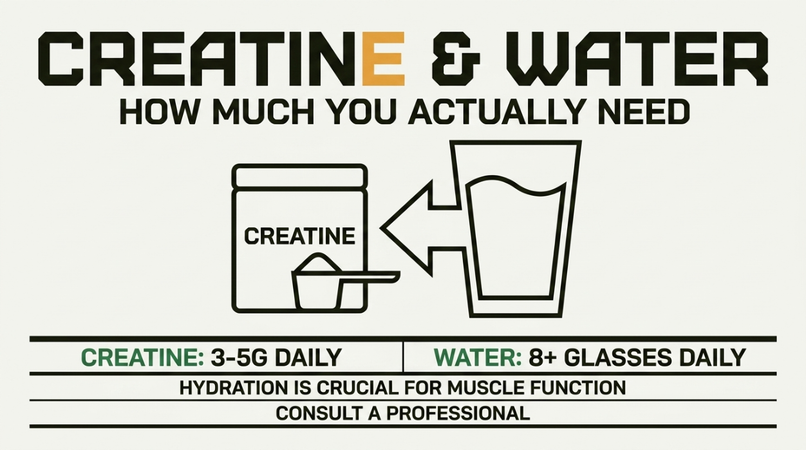
Short answer: creatine does not require unusually high water intake. It pulls water into muscle cells, which is part of how it works and why you gain a kilogram or two early on, but position stands do not specify an elevated fluid requirement for healthy users. The older claims that creatine causes dehydration, cramping and heat illness have been tested repeatedly and not supported.
Calculate your dose, mixing volume and daily fluid target.
What creatine actually does to body water
Creatine is osmotically active. When muscle creatine stores rise, water follows into the cell, increasing intracellular fluid. This is cell volumisation, and it is associated with the small weight gain most people see in the first one to four weeks.
The important distinction is intracellular rather than subcutaneous. The water sits inside muscle cells, not under the skin, which is why creatine does not produce the puffy appearance people sometimes fear. If anything it makes muscles look fuller.
What to expect on the scale
- Loading with 20 g daily: typically 1 to 2 kg within the first week.
- Steady 3 to 5 g daily: the same gain spread over three to four weeks.
- After saturation: weight stabilises. Continued gain past that point is coming from somewhere else.
The dehydration myth, and where it came from
In the late 1990s, governing bodies and some clinicians warned that creatine might increase risk of dehydration, cramping and heat illness in athletes. The reasoning was superficially plausible: if creatine draws water into muscle, less might be available elsewhere.
Studies since have not borne this out. Dalbo and colleagues reviewed the evidence and concluded the cramping and dehydration concerns were not supported. Lopez and colleagues examined heat tolerance and hydration status specifically and found creatine did not hinder either. Several studies have found the reverse of the prediction, with increased total body water potentially aiding thermoregulation.
The ISSN position stand states plainly that creatine does not increase the incidence of cramping, dehydration or injury.
So how much should you drink?
The same as you should be drinking anyway. A common practical baseline is around 35 ml per kilogram of bodyweight daily, plus roughly 350 ml per 30 minutes of training, adjusted upward in heat.
| Bodyweight | No training | 45 min training | 90 min in heat |
|---|---|---|---|
| 60 kg | 2.1 L | 2.6 L | 3.4 L |
| 75 kg | 2.6 L | 3.1 L | 4.0 L |
| 90 kg | 3.2 L | 3.7 L | 4.7 L |
| 105 kg | 3.7 L | 4.2 L | 5.3 L |
Adding a few hundred millilitres during a loading phase is reasonable, since you are moving more water into muscle over a short period. Drinking four or five litres because a forum post said creatine demands it is unnecessary, and very large intakes carry their own risks.
Mixing it properly
- 250 to 350 ml per 5 g dose is plenty to dissolve monohydrate.
- Warm liquid dissolves it better. Grit at the bottom of the glass is creatine you did not take.
- Do not mix in advance. Creatine degrades to creatinine in solution over hours, which is also why liquid creatine products are a poor choice.
- Any liquid works. Water, juice, a protein shake. The old advice to take it with fast carbohydrates has a small insulin-mediated basis but makes little practical difference.
- Timing does not matter. Daily consistency saturates the muscle; the clock does not.
Digestive discomfort is a dose problem
The most common complaint, particularly during loading, is stomach upset or loose stools. This is almost always about taking too much at once rather than creatine itself. Splitting a 20 g loading dose into four 5 g servings across the day resolves it for most people, and skipping loading entirely avoids it.
Loading versus steady dosing compared.
Who should ask a doctor first
Creatine has an unusually large safety literature in healthy adults, with no greater rate of adverse events than placebo across hundreds of trials. Existing kidney disease is the clear exception, and anyone with reduced kidney function or taking medication affecting the kidneys should discuss it with their doctor rather than relying on general reassurance.
One practical note: creatine supplementation raises serum creatinine, a marker used to estimate kidney function. That rise reflects creatine metabolism rather than kidney damage, but it can cause confusion on a blood test. Tell your doctor you take it.
FAQ
How much water should I drink on creatine?
Normal daily needs, roughly 35 ml per kg plus training losses. No special elevated requirement has been established.
Does creatine dehydrate you?
Research has not supported this. Studies on hydration status and heat tolerance found no impairment.
Does creatine cause cramps?
Reviews have found no increase in cramping, and some studies report fewer cramps in creatine users.
Why did I gain 2 kg in a week?
Intracellular water during loading. It is not fat, and it stabilises once stores are saturated.
Sources
- Kreider RB et al. ISSN position stand: safety and efficacy of creatine supplementation in exercise, sport, and medicine. JISSN, 2017.
- Dalbo VJ, Roberts MD, Stout JR, Kerksick CM. Putting to rest the myth of creatine supplementation leading to muscle cramps and dehydration. British Journal of Sports Medicine, 2008.
- Lopez RM et al. Does creatine supplementation hinder exercise heat tolerance or hydration status? Journal of Athletic Training, 2009.
- Antonio J et al. Common questions and misconceptions about creatine supplementation. JISSN, 2021.
- Institute of Medicine. Dietary Reference Intakes for Water, Potassium, Sodium, Chloride and Sulfate, 2005.
General information, not medical advice. Discuss creatine with your doctor if you have kidney disease or take medication affecting kidney function.
GramGoal Team. We build nutrition calculators and price-check the supplement market monthly. General information, not medical advice. See our methodology and affiliate disclosure.