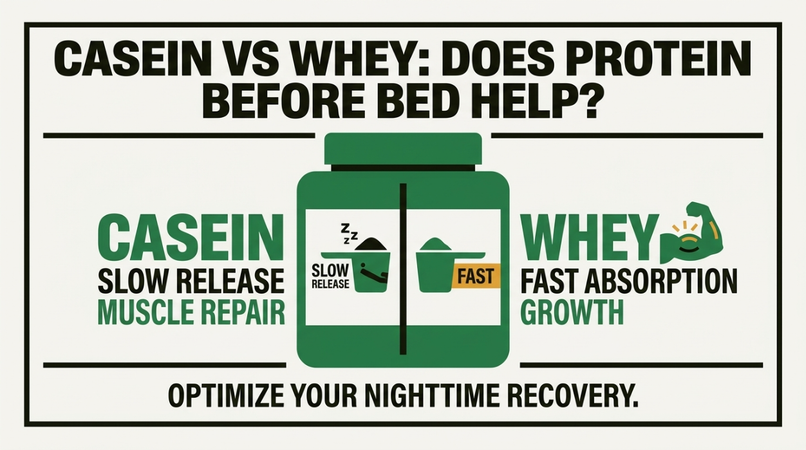
Short answer: casein digests slowly, releasing amino acids over several hours, which is why it is marketed for overnight muscle protein synthesis. The supporting evidence is real but modest. Total daily protein still matters far more, and a bowl of Greek yogurt or cottage cheese does the same job as a casein shake.
Set your daily protein target firstFree calculator →How casein and whey differ
Both come from milk, which is roughly 80 percent casein and 20 percent whey. Whey is soluble and absorbs quickly, producing a fast, high peak in blood amino acids that fades within a couple of hours. Casein forms a gel in stomach acid, slowing digestion so amino acids release gradually over six or seven hours.
Neither is better in the abstract. They have different release curves, and the useful question is what you are trying to cover.
The overnight argument
Sleep is the longest daily gap without protein, typically seven to nine hours. Muscle protein synthesis falls during that window. Studies giving 30 to 40 g of casein before sleep have reported increased overnight synthesis and, over longer training studies, modest additional gains in muscle mass and strength.
The honest caveat is that several of these studies added pre-sleep protein on top of an already adequate intake, which makes it hard to separate the effect of timing from the effect of simply eating more protein. When total intake is matched, the advantage shrinks considerably.
When pre-sleep protein is worth it
- You are struggling to hit your daily target. An extra 30 to 40 g before bed is an easy feeding opportunity.
- You train in the evening. Recovery continues overnight, and going to bed without protein after a late session wastes the window.
- Your protein is unevenly distributed. If dinner is your only large protein meal, adding a pre-sleep feeding improves the spread.
- You are older. Anabolic resistance means the overnight gap matters more, and a larger pre-sleep dose may help.
If you already hit a well-distributed target across the day, adding casein is a refinement worth a few percent, not a transformation.
You do not need a casein powder
Casein is simply milk protein. Whole foods deliver it at lower cost:
- Cottage cheese, 200 g: about 22 g protein, mostly casein
- Greek yogurt, 200 g: about 20 g protein
- Milk, 500 ml: about 17 g protein
- Casein powder, 1 scoop: about 24 g protein
Compare on cost per 20 g of protein before buying a dedicated powder. For many people, cottage cheese wins on both price and satiety.
What about whey before bed?
It works, just with a shorter release curve. If whey is what you have, use it rather than skipping the feeding. The difference between whey and casein at bedtime is far smaller than the difference between having protein and not having it.
More on why total intake and distribution beat timing.
FAQ
Should I take casein before bed?
Useful if it helps you reach your daily target or improves distribution. A refinement rather than a requirement.
How much protein before sleep?
Studies typically used 30 to 40 g, with the larger doses more relevant for older adults.
Is cottage cheese as good as casein powder?
Effectively yes. It is predominantly casein, and usually cheaper per gram of protein.
Does eating before bed cause fat gain?
No. Total daily calories determine that, not the clock.
General information, not medical advice.
GramGoal Team. We build nutrition calculators and price-check the supplement market monthly. General information, not medical advice. See our methodology and affiliate disclosure.