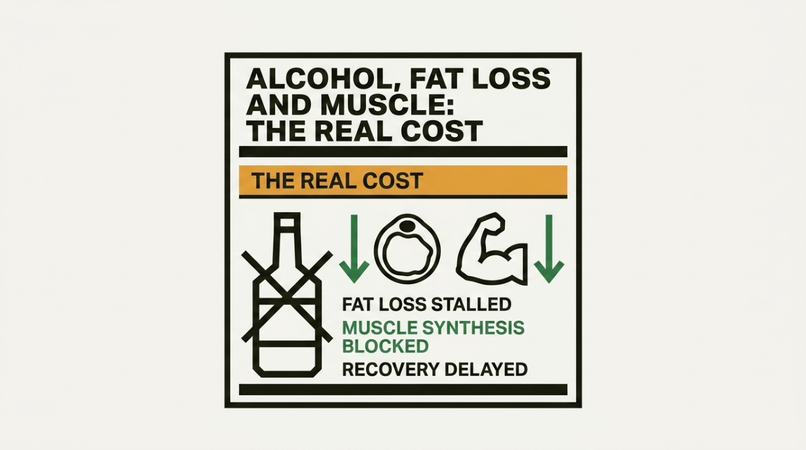
Short answer: alcohol works against fat loss and muscle gain through several mechanisms at once, and the calories are only part of it. It suppresses fat oxidation while your body clears it, blunts muscle protein synthesis after training, degrades sleep quality, and lowers dietary restraint. Moderate occasional drinking is compatible with progress; regular drinking makes everything harder.
The calories, which are the smallest problem
| Drink | Serving | Calories |
|---|---|---|
| Beer, 5% | 330 ml | About 145 |
| Wine | 175 ml | About 160 |
| Spirit with diet mixer | 50 ml | About 110 |
| Spirit with regular mixer | 50 ml + 200 ml | About 190 |
| Cocktail | Varies | 250-500 |
Alcohol supplies 7 calories per gram, between carbohydrate and fat. Four drinks is commonly 600 to 800 calories, which for most people erases a day of deficit. But if calories were the whole story, alcohol would be no worse than any other 600 calories, and it is.
What else it does
- Fat oxidation is suppressed. The body treats alcohol as a priority to clear because it cannot be stored. While that happens, fat burning is reduced and other fuels are diverted toward storage.
- Muscle protein synthesis is blunted. Research has found substantial reductions in post-exercise MPS when alcohol is consumed after training, even when protein intake is adequate.
- Sleep quality falls. Alcohol shortens time to fall asleep and then fragments the second half of the night, suppressing REM. Why sleep matters here.
- Dietary restraint drops. The reliable real-world effect. Late-night eating decisions after drinking rarely favour your targets.
- Testosterone falls acutely after heavy intake, though moderate drinking shows smaller effects.
How to limit the damage
- Do not drink close to training. If you lift, put the session and the drinking on different days where possible.
- Eat protein first. A meal with 30 to 40 g of protein before drinking helps both satiety and decision-making.
- Choose lower calorie drinks. Spirits with a zero-calorie mixer are the cheapest option in calories.
- Count it. Alcohol calories are the most commonly untracked calories in any diet.
- Plan for it. Reducing intake slightly across the day is more effective than pretending the evening will not happen.
- Hydrate and prioritise sleep after, because the recovery cost is where the training impact shows up.
How much is too much?
For body composition specifically, occasional moderate drinking has small measurable effects. Regular drinking, particularly close to training, compounds. National guidance in most countries sits around fourteen units weekly with several drink-free days, and that is a health recommendation rather than a physique one.
Worth being honest: there is no intake at which alcohol helps body composition. The question is what trade-off you are willing to make, which is a legitimate personal decision rather than a nutritional one.
FAQ
Does alcohol stop fat loss?
It does not stop it, but it suppresses fat oxidation while being cleared and adds calories that are easy to miss.
Does alcohol kill your gains?
Post-exercise muscle protein synthesis is measurably reduced by alcohol. Occasional drinking is unlikely to matter much; regular drinking after training does.
Which alcohol is best for weight loss?
Spirits with a zero-calorie mixer, at roughly 110 calories per measure. Cocktails and regular mixers are the most expensive in calories.
Can I drink and still build muscle?
Yes, with moderate intake, adequate protein, good sleep and separation from training days.
Sources
- Parr EB et al. Alcohol ingestion impairs maximal post-exercise rates of myofibrillar protein synthesis. PLOS ONE, 2014.
- Shelmet JJ et al. Ethanol causes acute inhibition of carbohydrate, fat, and protein oxidation. Journal of Clinical Investigation, 1988.
- Ebrahim IO et al. Alcohol and sleep: effects on normal sleep. Alcoholism: Clinical and Experimental Research, 2013.
- Centers for Disease Control and Prevention. Dietary Guidelines on alcohol. cdc.gov
- NHS. Alcohol units and low risk drinking guidance. nhs.uk
General information, not medical advice. If alcohol use is a concern, speak to your doctor or a support service.
Calculate what your drinking costs per week and month.
GramGoal Team. We build nutrition calculators and price-check the supplement market monthly. General information, not medical advice. See our methodology and affiliate disclosure.