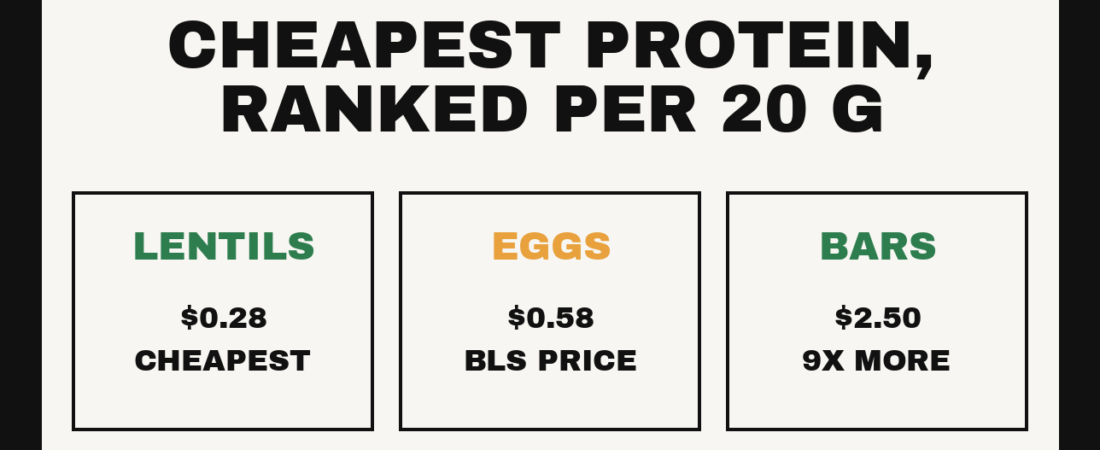
Short answer: dried lentils and beans, bulk whey powder, eggs, milk and whole chicken are the cheapest protein in a US supermarket right now. At July 2026 average prices, eggs deliver 20 g of protein for about 58 cents and whole milk for about 69 cents, while a protein bar costs roughly $2.50 for the same 20 g. The spread between the cheapest and the most expensive source is about ninefold, and almost none of it is explained by quality.
Run your own prices through the comparator or work out how many grams you need first.
Cost per 20 g of protein, ranked
Twenty grams is a useful unit because it is roughly one meal-sized dose and one scoop of powder. Rows marked BLS use US Bureau of Labor Statistics average retail prices for July 2026, the most recent published month. The rest are typical US retail prices in September 2026 and will move with your store, your region and whatever is on offer that week.
| Source | Price used | Cost per 20 g protein | Price source |
|---|---|---|---|
| Dried lentils | $1.60 / lb | $0.28 | Typical retail |
| Textured vegetable protein | $4.00 / lb | $0.35 | Typical retail |
| Dried black beans | $1.70 / lb | $0.35 | Typical retail |
| Eggs, large | $2.19 / dozen | $0.58 | BLS |
| Whey concentrate, bulk | $55 / 5 lb | $0.62 | Typical retail |
| Whole chicken | $1.70 / lb | $0.62 | Typical retail |
| Peanut butter | $3.50 / 16 oz | $0.67 | Typical retail |
| Whole milk | $4.31 / gallon | $0.69 | BLS |
| Whey isolate | $70 / 5 lb | $0.71 | Typical retail |
| Pork loin | $3.50 / lb | $0.73 | Typical retail |
| Firm tofu | $2.50 / 14 oz | $0.74 | Typical retail |
| Chicken breast, boneless | $4.15 / lb | $0.81 | BLS |
| Canned black beans | $1.10 / 15 oz | $1.05 | Typical retail |
| Cottage cheese | $4.00 / 24 oz | $1.07 | Typical retail |
| Canned tuna | $1.20 / 5 oz | $1.09 | Typical retail |
| American cheese | $4.75 / lb | $1.20 | BLS |
| Greek yogurt, plain | $5.50 / 32 oz | $1.21 | Typical retail |
| Canned sardines | $1.80 / 3.75 oz | $1.36 | Typical retail |
| Ground beef | $6.89 / lb | $1.73 | BLS |
| Sirloin steak | $9.00 / lb | $1.89 | Typical retail |
| Ready-to-drink shake | $3.00 / 30 g | $2.00 | Typical retail |
| Salmon fillet | $11.00 / lb | $2.43 | Typical retail |
| Protein bar | $2.50 / 20 g | $2.50 | Typical retail |
Protein content per 100 g comes from USDA FoodData Central; the full table is in protein per 100 g. Meats are costed on raw weight, since cooking removes water but not protein.
What the ranking actually shows
Convenience is the whole premium
A protein bar and a bulk tub of whey deliver chemically similar protein. The bar costs four times more per gram. Dry black beans cost 35 cents per 20 g; the same beans in a can cost $1.05, a threefold markup for having been soaked and cooked for you. That is a real service and sometimes worth paying for, but it should be a conscious purchase rather than a default.
Powder is cheap protein, not expensive protein
Bulk whey concentrate sits between eggs and milk on this list, below chicken breast. The reputation of powder as a luxury comes from single-serve formats and flavour-of-the-month branding, not from whey itself. Cheapest whey per 20 g and concentrate versus isolate break down where the money goes.
Cheap legumes carry a quality discount
Lentils win on price by a wide margin, but they score about 0.75 on DIAAS against roughly 1.10 for beef or egg, meaning less of each indispensable amino acid survives digestion. Adjusting for that, lentils still win, just by less: closer to 41 cents than 28 cents in quality-matched terms. Mixing legumes with grains or a little dairy closes most of the gap, which is the point the vegan and vegetarian guide works through.
Cheapest per gram is not cheapest per meal
Ground beef looks expensive at $1.73 per 20 g, but fatty ground beef is also delivering calories you would otherwise buy elsewhere. Dry beans need 45 minutes of cooking and a plan. Skimmed milk powder is cheaper per gram than fresh milk and nobody drinks it straight. Price per gram is one axis; time, palatability and what else the food brings are the others.
A cheap 130 g protein day
| Meal | Protein | Approx. cost |
|---|---|---|
| 3 eggs plus 300 ml milk | 29 g | $0.90 |
| 200 g cooked lentils with rice | 22 g | $0.45 |
| 1 scoop bulk whey concentrate | 25 g | $0.73 |
| 200 g chicken breast, raw weight | 45 g | $1.83 |
| 200 g cottage cheese | 22 g | $1.18 |
| Total | 143 g | $5.09 |
That is protein alone, not a full day of food. It does show that a high protein intake is not inherently a premium purchase: 143 g for roughly five dollars is about what two protein bars cost.
Where the evidence is thin
- No trial has tested cost-optimised protein. There is no randomised study showing that people who source protein cheaply end up with different body composition than people who buy expensive sources, at matched total protein and calories. The literature supports total daily intake and training; it says almost nothing about which aisle you bought it from.
- Price data is coarse. BLS average prices are national urban averages across 75 areas. Your store can differ by 30 percent, and store-brand versus name-brand often matters more than the food category.
- Prices move faster than articles. Eggs in particular have swung sharply in recent years. Treat this ranking as a structure, not a set of fixed numbers, and re-run it with today’s shelf prices.
- DIAAS adjustments are approximate. Scores are measured on isolated proteins in controlled conditions, and a mixed meal behaves better than its worst ingredient.
FAQ
What is the cheapest source of protein?
Dried lentils, at roughly 28 cents per 20 g of protein. Dried beans and textured vegetable protein are close behind at about 35 cents.
What are the cheapest high protein foods that are not beans?
Eggs at about 58 cents per 20 g, bulk whey concentrate and whole chicken at about 62 cents, and whole milk at 69 cents.
Are protein bars a rip-off?
On price per gram, yes: roughly nine times the cost of lentils and four times the cost of bulk whey. What you buy is portability. If a bar is what stops you skipping the protein entirely, it earns its price.
Is cheap protein lower quality?
Not usually. Eggs, milk and bulk whey score at the top of the DIAAS range and near the bottom of the price range. Only the plant sources carry a genuine quality discount, and mixing sources largely offsets it.
How do I work out cost per gram of protein myself?
Divide the package price by the grams of protein in the whole package. Or put the numbers into the cost per serving comparator, which does it for two products side by side.
Sources
- US Bureau of Labor Statistics. Average Price Data, Consumer Price Index programme, July 2026 release.
- USDA FoodData Central. Agricultural Research Service, US Department of Agriculture.
- Drewnowski A. The cost of US foods as related to their nutritive value. American Journal of Clinical Nutrition, 2010.
- Herreman L, Nommensen P, Pennings B, Laus MC. Comprehensive overview of the quality of plant- and animal-sourced proteins based on the digestible indispensable amino acid score. Food Science and Nutrition, 2020.
- Morton RW et al. A systematic review, meta-analysis and meta-regression of the effect of protein supplementation on resistance training-induced gains in muscle mass and strength. British Journal of Sports Medicine, 2018.
- Jager R et al. International Society of Sports Nutrition position stand: protein and exercise. JISSN, 2017.
Prices are illustrative and change constantly. General information, not medical advice.
GramGoal Team. We build nutrition calculators and price-check the supplement market monthly. General information, not medical advice. See our methodology and affiliate disclosure.