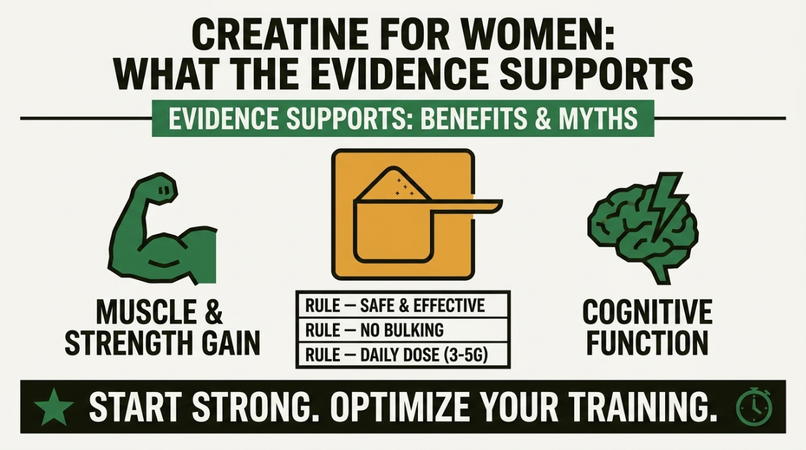
Short answer: the protocol is the same as for men. Creatine monohydrate, 3 to 5 g daily, taken consistently and paired with resistance training. A loading phase is optional. The reason it is discussed separately for women is that most creatine research historically studied male athletes, and the female-specific evidence has only recently started catching up.
Get your dose or set your protein and calorie targets first, since neither supplement matters much without those in place.
Why women may respond somewhat differently
Women tend to have lower baseline creatine stores than men, partly because of lower muscle mass and partly because dietary creatine comes mainly from red meat and fish, which women on average eat less of. Lower starting stores mean more room to top up, and several researchers have suggested this is why some cognitive and mood effects appear more pronounced in women.
Hormonal fluctuation across the menstrual cycle and life stages also affects creatine metabolism, which is an active research area rather than a settled one.
Where the evidence is strongest
- Strength and lean mass. The best-supported use. For women who resistance train, creatine produces modest additional gains, with the clearest evidence in older and postmenopausal women.
- Cognition. A trial in peri- and postmenopausal women found improvements in reaction time alongside increased frontal brain creatine, though it was short and used a different formulation from standard monohydrate.
- Sleep. One placebo-controlled study found longer sleep duration in naturally menstruating women taking creatine. Early, single-study evidence.
- Bone. Creatine alone does not appear to meaningfully raise bone mineral density. Combined with resistance training, some evidence suggests it may support structural properties related to fracture resistance. Promising rather than proven.
The bulking myth
This is the most common reason women avoid creatine, and it is misplaced. Creatine draws water into muscle cells, which can add one to two kilograms of scale weight in the first weeks. That is intracellular water, not fat, and it is part of the mechanism rather than a side effect. It does not cause the appearance most people mean by bulky, which requires years of dedicated training and a calorie surplus.
If scale weight matters to you, expect that initial jump and judge progress by measurements and strength instead. The recomp calculator explains why the scale is a poor measure during body composition change.
Practical protocol
- Form: creatine monohydrate. It is the form with the overwhelming majority of the research and the cheapest per gram.
- Dose: 3 to 5 g daily. Smaller women can sit at the lower end.
- Timing: any time, with any meal. Consistency matters, timing does not.
- Rest days: yes, take it. The goal is maintaining saturated stores, not fuelling a session.
- Cycling: unnecessary. There is no evidence supporting on-off cycles.
- Pair it with training. Creatine supports the work; it does not replace it.
What the research still needs
Being honest about the gaps: there is no adequately powered controlled perimenopause trial using standard monohydrate with proper staging, no bone trial with geometric endpoints as the primary outcome, and no dose-response work establishing what brain creatine dose produces meaningful cognitive effects. The strength and lean mass evidence is solid. Much of the rest is encouraging early signal being marketed as established fact.
FAQ
Will creatine make me gain weight?
One to two kilograms of water weight in the first weeks, held inside the muscle. It does not cause fat gain.
Should women take a lower creatine dose?
3 to 5 g suits most women. Bodyweight is the main consideration, not sex.
Is creatine safe during menopause?
The research in postmenopausal women is among the more positive parts of the literature, particularly alongside resistance training. Existing medical conditions warrant a conversation with your doctor.
Can I take creatine while pregnant or breastfeeding?
There is insufficient evidence to make a recommendation, so this is a question for your doctor rather than a website.
General information, not medical advice.
GramGoal Team. We build nutrition calculators and price-check the supplement market monthly. General information, not medical advice. See our methodology and affiliate disclosure.