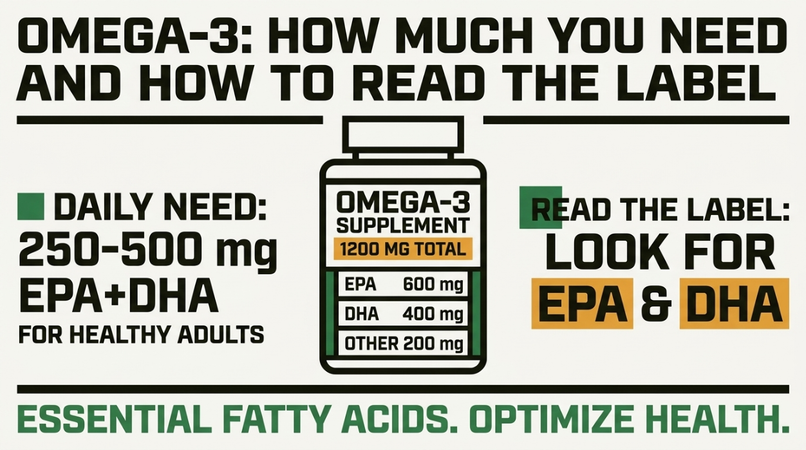
Short answer: most adults get far less omega-3 than health bodies suggest, and the two forms that matter most, EPA and DHA, come almost entirely from oily fish. Plant sources supply ALA, which the body converts to EPA and DHA at a rate low enough that it rarely covers the gap on its own. A common target is 250 to 500 mg of combined EPA and DHA per day.
The three omega-3s, and why the distinction matters
- ALA (alpha-linolenic acid). Found in flaxseed, chia, walnuts and rapeseed oil. It is the only omega-3 that is strictly essential in the diet, but its direct benefits are modest.
- EPA (eicosapentaenoic acid). Mainly from oily fish and algae. Most associated with cardiovascular and inflammatory research.
- DHA (docosahexaenoic acid). Also from oily fish and algae. A major structural component of brain and retinal tissue.
The conversion problem is the crux. The body converts ALA to EPA at a low single-digit percentage, and to DHA at a rate lower still, with women converting somewhat better than men. Eating flaxseed is worthwhile, but it is not equivalent to eating salmon.
How much do you need?
Health authorities generally suggest 250 to 500 mg of combined EPA and DHA daily for general health, which is roughly what two servings of oily fish a week provides. Higher intakes are sometimes used for specific purposes such as elevated triglycerides, and those situations belong with a doctor rather than a self-directed dose increase.
EPA and DHA in common foods
- Salmon, farmed, 100 g: roughly 2,000 mg
- Mackerel, 100 g: roughly 2,500 mg
- Sardines, 100 g: roughly 1,400 mg
- Herring, 100 g: roughly 1,700 mg
- Tuna, canned in water, 100 g: roughly 250 mg
- Standard fish oil capsule: often 300 mg combined, so check the label
- Algae oil capsule: typically 300 to 500 mg, and suitable for vegans
Two portions of oily fish a week comfortably meets the general target. If you rarely eat fish, that is the gap a supplement is genuinely filling.
Reading a fish oil label properly
This is where most people are misled. A capsule advertised as 1,000 mg fish oil frequently contains only around 300 mg of combined EPA and DHA; the rest is other fats. The number that matters is on the back, not the front.
- Check EPA and DHA separately and add them. Ignore the total fish oil figure.
- Triglyceride form is absorbed somewhat better than ethyl ester, though both work and ethyl ester is cheaper.
- Look for third-party testing. Oxidation is a real issue with fish oil, and rancid product is both less effective and unpleasant.
- Algae oil is the vegan route to actual EPA and DHA rather than relying on ALA conversion.
- Store it cool and dark, and discard anything that smells strongly rancid.
Where the evidence is strong, and where it is not
Omega-3 has robust evidence for lowering triglycerides and reasonable evidence for supporting cardiovascular health in people with low intake. Evidence around brain health, mood and joint comfort is more mixed, with some positive findings and some null results in large trials. It is a well-studied nutrient worth getting adequate amounts of, not a cure-all, and the search surge around it has outpaced the strength of some claims being made.
FAQ
How much omega-3 per day should I take?
250 to 500 mg combined EPA and DHA daily covers general health for most adults. Higher therapeutic doses should be discussed with a doctor.
Is fish oil or algae oil better?
Both provide EPA and DHA directly. Algae oil suits vegans and avoids fish contaminant concerns; fish oil is usually cheaper per milligram.
Can I get enough omega-3 from flaxseed?
Flaxseed supplies ALA, which converts to EPA and DHA inefficiently. It contributes but rarely covers the target alone.
Should I take omega-3 with food?
Yes. Taking it with a meal containing fat improves absorption and reduces the fishy aftertaste people complain about.
General information, not medical advice. Omega-3 at higher doses can interact with blood-thinning medication, so speak to your doctor if you take anticoagulants.
Work out your EPA and DHA gap and how many capsules close it.
GramGoal Team. We build nutrition calculators and price-check the supplement market monthly. General information, not medical advice. See our methodology and affiliate disclosure.