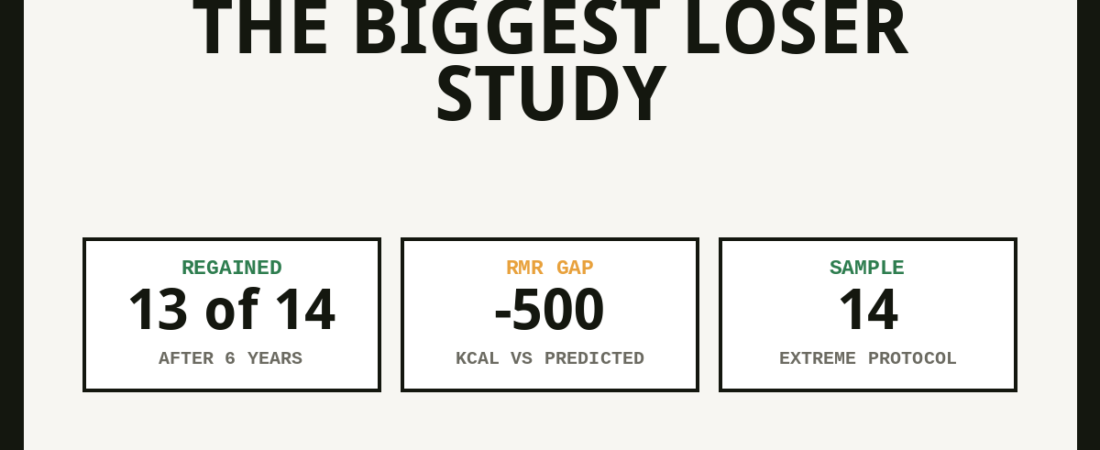
Short answer: Fothergill and colleagues 2016 followed 14 contestants from The Biggest Loser for six years after the competition. Thirteen of the fourteen regained weight. More striking, their resting metabolic rate remained roughly 500 calories per day below what their body size predicted, six years later. The adaptation did not resolve.
Estimate your own post-diet maintenance.
What the study found
| Timepoint | Average weight | RMR vs predicted |
|---|---|---|
| Start of competition | About 148 kg | Normal |
| End, 30 weeks | About 90 kg | About 610 kcal below |
| Six years later | About 132 kg | About 500 kcal below |
The pattern that alarmed researchers: participants regained most of the weight, yet metabolic rate did not recover alongside it. Adaptation persisted despite the weight returning.
Why this study gets over-read
It is widely cited as proof that dieting permanently breaks your metabolism. That reading goes considerably beyond what fourteen people in extreme circumstances can support.
- The intervention was extreme. Roughly 40 percent of bodyweight lost in 30 weeks, through severe restriction combined with several hours of daily exercise. This is not comparable to a moderate diet.
- Fourteen participants. Small, self-selected, and drawn from a television competition.
- Contradicting evidence exists. Follow-ups of bariatric surgery patients and other weight loss cohorts have generally found adaptation that diminishes over time, not persistent suppression of this magnitude.
- Lean mass loss was substantial, which accounts for part of the reduced expenditure through a mechanism that is not mysterious.
What it does support
Two conclusions are reasonable from this work, and they matter.
Rapid, aggressive weight loss carries a metabolic cost that a moderate approach appears to avoid or reduce. The intervention here was about as aggressive as any studied.
Maintenance is a distinct phase requiring its own plan. Thirteen of fourteen regaining is a stark illustration that losing weight and keeping it off are different problems, and the second gets far less attention.
What to do differently
- Moderate deficits, 15 to 25 percent rather than extreme restriction. Set one properly.
- High protein and resistance training throughout, which protects the lean mass driving expenditure.
- Diet breaks during longer phases. The MATADOR evidence.
- Plan maintenance before you need it, since that is where this cohort struggled most.
Full breakdown of adaptive thermogenesis.
FAQ
What did the Biggest Loser study find?
Thirteen of fourteen contestants regained weight over six years, and resting metabolic rate remained around 500 kcal below predicted.
Does dieting permanently damage metabolism?
This study is the strongest evidence for persistent adaptation, but it involved extreme weight loss in fourteen people. Broader evidence suggests adaptation that diminishes with weight regain and normal eating.
How many people were studied?
Fourteen, followed for six years after a 30 week competition.
Should this discourage me from dieting?
No. It argues for moderate rates, adequate protein, resistance training and a maintenance plan, rather than against fat loss.
Sources
- Fothergill E et al. Persistent metabolic adaptation 6 years after The Biggest Loser competition. Obesity, 2016.
- Rosenbaum M, Leibel RL. Adaptive thermogenesis in humans. International Journal of Obesity, 2010.
- Muller MJ, Enderle J, Bosy-Westphal A. Changes in Energy Expenditure with Weight Gain and Weight Loss in Humans. Current Obesity Reports, 2016.
- Byrne NM et al. Intermittent energy restriction improves weight loss efficiency: the MATADOR study. IJO, 2018.
General information, not medical advice.
Part of The Research — studies and position stands explained plainly.
GramGoal Team. We build nutrition calculators and price-check the supplement market monthly. General information, not medical advice. See our methodology and affiliate disclosure.