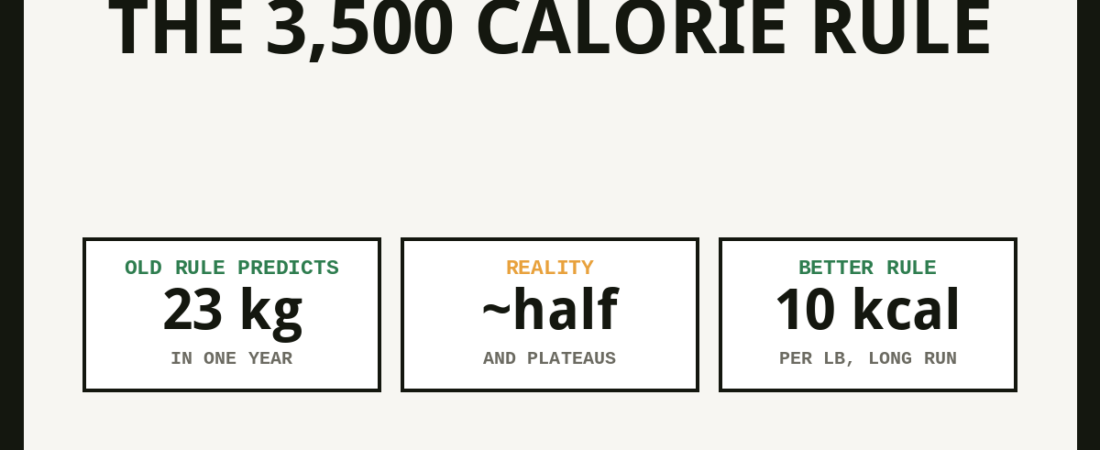
Short answer: the 3,500 calories per pound rule is wrong, and Kevin Hall work at the National Institutes of Health is why we know. The rule assumes a fixed linear relationship that overestimates weight loss substantially over time, because it ignores the fall in energy expenditure that accompanies a smaller body. Hall dynamic model replaced it.
Where the 3,500 rule came from
It originates with Max Wishnofsky in 1958, who calculated that a pound of body fat stores roughly 3,500 calories. That arithmetic is approximately correct for the tissue itself.
The error is in what people did with it. Treating 3,500 as a fixed exchange rate implies that a daily 500 calorie deficit produces one pound of loss every week indefinitely. Over a year that predicts 52 pounds. Real outcomes are consistently and substantially lower.
Why it breaks down
- A smaller body burns less. As weight falls, both resting metabolic rate and the energy cost of movement decline, shrinking the deficit at the same intake.
- Adaptive thermogenesis. Expenditure falls beyond what body size alone predicts, driven by reduced spontaneous activity and hormonal changes.
- Composition of loss changes. Early loss includes glycogen and water; later loss is proportionally more fat, and the energy densities differ.
- Adherence drifts. Intake creeps up in ways people do not notice, which the model cannot capture but which explains much of the gap in practice.
What the dynamic model predicts instead
Hall and colleagues built a validated model of human energy balance that accounts for these changes. Its headline rule of thumb differs sharply from the old one.
| Rule | Prediction from a 500 kcal daily deficit |
|---|---|
| 3,500 rule | About 23 kg in one year, continuing indefinitely |
| Hall dynamic model | Roughly half that, approaching a plateau |
The model also gives a more useful framing: every permanent change of about 10 calories per day leads to roughly one pound of weight change, with half of that achieved in about a year and most within three.
What this means practically
Three things follow, and they are more encouraging than they sound.
- Plateaus are expected physiology, not evidence of failure or a broken metabolism. As you get lighter, the same intake becomes a smaller deficit.
- Targets need recalculating as you lose weight. Recalculate maintenance.
- Linear timeline predictions are optimistic by design. Any calculator promising steady loss for a year is using the wrong model.
The honest caveat
Hall model is a model. It predicts population averages well and individuals imperfectly, because adherence, activity and individual variation all sit outside it. Its value is directional: it tells you to expect deceleration, which the 3,500 rule actively hides.
FAQ
Is the 3,500 calorie rule accurate?
Not over time. It is roughly correct for the energy stored in a pound of fat but wrong as a prediction rule, because it ignores falling expenditure.
Why did my weight loss slow down?
A smaller body burns less, so the same intake represents a smaller deficit. This is expected, not failure.
What replaced the 3,500 rule?
Dynamic energy balance models, principally Hall work at the NIH, which account for changing expenditure.
How much can I actually lose in a year?
Considerably less than linear arithmetic predicts, with the rate slowing as you approach a new equilibrium.
Sources
- Hall KD et al. Quantification of the effect of energy imbalance on bodyweight. The Lancet, 2011.
- Hall KD. What is the required energy deficit per unit weight loss? International Journal of Obesity, 2008.
- Thomas DM et al. Can a weight loss of one pound a week be achieved with a 3500-kcal deficit? Journal of the Academy of Nutrition and Dietetics, 2014.
- Wishnofsky M. Caloric equivalents of gained or lost weight. American Journal of Clinical Nutrition, 1958.
General information, not medical advice.
Part of The Research — studies and position stands explained plainly.
GramGoal Team. We build nutrition calculators and price-check the supplement market monthly. General information, not medical advice. See our methodology and affiliate disclosure.