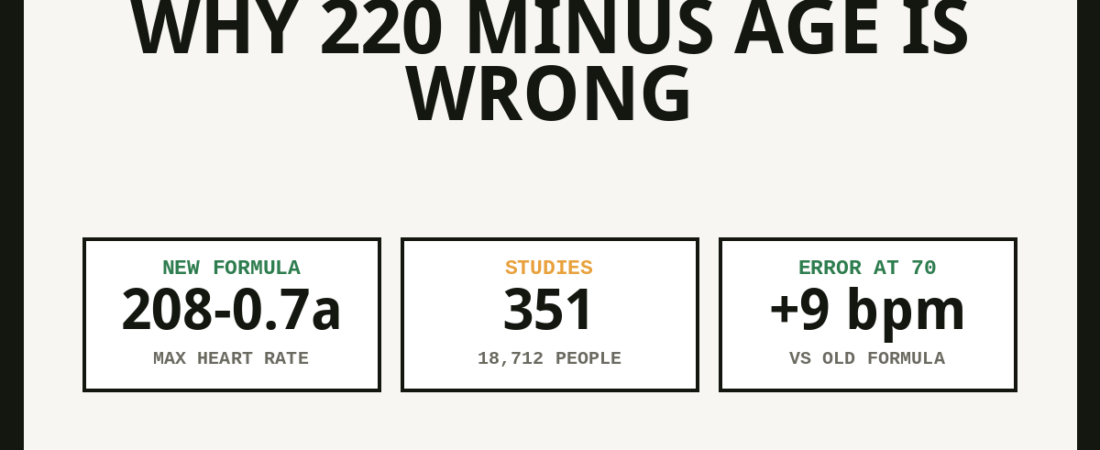
Short answer: Tanaka, Monahan and Seals 2001 analysed 351 studies covering 18,712 people and concluded that the familiar 220 minus age formula is inaccurate, particularly in older adults. Their replacement, 208 minus 0.7 times age, predicts maximum heart rate more reliably and is independent of sex and habitual activity level.
Calculate your zones with the Tanaka formula.
The problem with 220 minus age
The 220 formula has no clear published derivation. It appears to have emerged from a rough observation in the 1970s and spread because it was easy to remember. The 2001 paper notes it lacks scientific merit as a prediction equation despite universal use.
Its practical failure is systematic rather than random. It underestimates maximum heart rate in older adults, which means people over roughly 40 are commonly given training zones that are too low, and their effort is misjudged as harder than it is.
The two formulas compared
| Age | 220 – age | Tanaka (208 – 0.7 x age) | Difference |
|---|---|---|---|
| 20 | 200 | 194 | -6 |
| 30 | 190 | 187 | -3 |
| 40 | 180 | 180 | 0 |
| 50 | 170 | 173 | +3 |
| 60 | 160 | 166 | +6 |
| 70 | 150 | 159 | +9 |
The formulas cross at age 40. Below that, 220 minus age overestimates; above it, it underestimates, and the gap widens with age. At 70 the difference is nine beats per minute, which shifts every training zone.
What the study did
Two parts. A meta-analysis of 351 published studies covering 18,712 subjects, then a laboratory validation in 514 healthy participants. That combination is why the equation has held up: it was both derived from a large pooled dataset and then tested prospectively.
The authors also found that maximum heart rate was independent of sex and of habitual physical activity, which is worth knowing because both are sometimes claimed to require adjustment.
The caveat that matters most
Any age-based formula carries substantial individual variation, with standard deviations of roughly 7 to 11 beats per minute. That means two 40 year olds could have genuine maximum heart rates 20 beats apart while both being entirely normal.
For training purposes this is why perceived effort and the talk test are useful alongside a number. If a formula says you are in zone 2 but you cannot speak in full sentences, trust your breathing over the arithmetic. More on zone 2.
FAQ
What is the Tanaka formula?
Maximum heart rate = 208 minus 0.7 times age, published in 2001 as a replacement for 220 minus age.
Is 220 minus age wrong?
It is systematically inaccurate, underestimating in older adults and overestimating in younger ones, with no clear derivation.
Does maximum heart rate differ by sex?
The study found it independent of sex and of habitual activity level.
How accurate is any formula?
Individual variation is roughly 7 to 11 beats either side. Use perceived effort alongside the number.
Sources
- Tanaka H, Monahan KD, Seals DR. Age-predicted maximal heart rate revisited. Journal of the American College of Cardiology, 2001.
- Gellish RL et al. Longitudinal modeling of the relationship between age and maximal heart rate. Medicine and Science in Sports and Exercise, 2007.
- American College of Sports Medicine. Guidelines for Exercise Testing and Prescription.
General information, not medical advice. Stop and seek advice for chest pain or unusual breathlessness during exercise.
Part of The Research — studies and position stands explained plainly.
GramGoal Team. We build nutrition calculators and price-check the supplement market monthly. General information, not medical advice. See our methodology and affiliate disclosure.