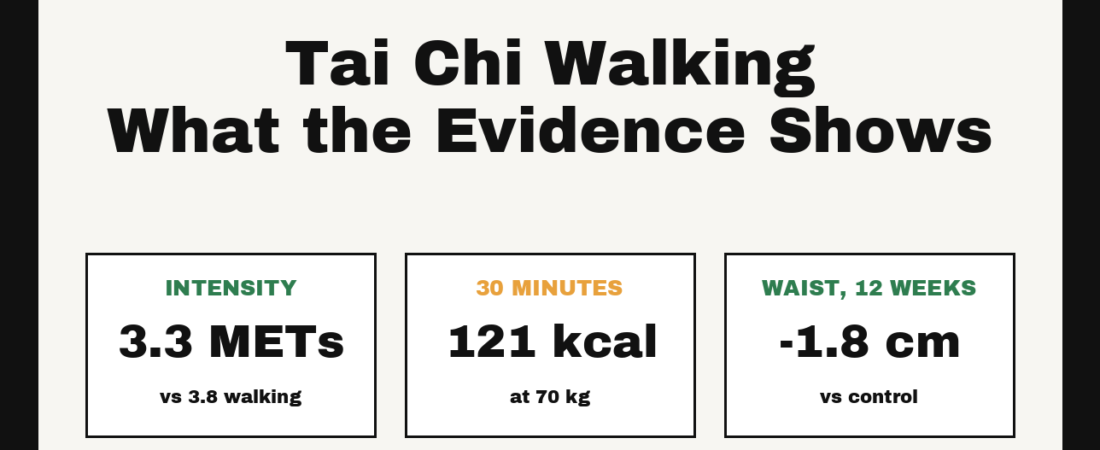
Short answer: tai chi walking is an indoor, low-impact routine that borrows tai chi’s slow weight-shifting and turns it into a stationary walking pattern. Energy cost is roughly that of an easy walk, around 120 kcal in half an hour for a 70 kg adult. Tai chi itself has genuinely good trial evidence for blood pressure and reasonable evidence for waist circumference. As a weight loss method specifically, nothing supports it beyond what any activity of the same intensity would deliver.
Work out your own figures: calories burned calculator.
What tai chi walking actually is
The format spreading through short-form video is a stationary or near-stationary walking pattern performed to a slow count: weight shifts fully onto one leg, the other foot places deliberately, arms move in a rounded tai chi-style arc. No equipment, no floor space beyond a couple of square metres, no impact. It is usually pitched at older adults, people in small flats, and anyone who wants movement without a treadmill.
It is worth being precise about what is being claimed. This is a packaging of tai chi’s stepping mechanics, not a studied intervention with its own literature. No trial has tested a routine called tai chi walking. What does exist is a substantial body of research on structured tai chi programmes, and that research is a reasonable guide as long as you do not over-read it.
What it burns
The Compendium of Physical Activities assigns general tai chi and qi gong 3.3 METs, which places it just below a moderate walk. Vigorous Yang-style practice is rated far higher, at 6.0, and seated practice far lower. Most of what circulates online sits at the lower end.
| Activity | METs | Compendium code |
|---|---|---|
| Tai chi, qi gong, sitting, light effort | 1.5 | 15672 |
| Tai chi, qi gong, general | 3.3 | 15670 |
| Walking 2.8 to 3.4 mph, level, moderate | 3.8 | 17190 |
| Walking 3.5 to 3.9 mph, level, brisk | 4.8 | 17200 |
| Tai chi chuan, Yang style | 6.0 | 15674 |
Converting those to calories for a 30 minute session, using the standard MET equation:
| Bodyweight | Tai chi, 30 min | Moderate walk, 30 min | Brisk walk, 30 min |
|---|---|---|---|
| 55 kg / 121 lb | About 95 kcal | About 110 kcal | About 139 kcal |
| 70 kg / 154 lb | About 121 kcal | About 140 kcal | About 176 kcal |
| 85 kg / 187 lb | About 147 kcal | About 170 kcal | About 214 kcal |
| 100 kg / 220 lb | About 173 kcal | About 200 kcal | About 252 kcal |
These are gross figures, including the calories you would have burned sitting still. The amount genuinely added by the session is roughly a quarter to a third lower. Either way the honest summary is that half an hour of this is worth about one biscuit more than half an hour of ordinary walking is worth, which is to say the difference between the formats is not where the value lies.
What the research supports
Two trials carry most of the weight here, and both are large and properly controlled.
| Trial | Design | Result |
|---|---|---|
| Li 2024, JAMA Network Open | 342 adults with prehypertension, 12 months, four 60-minute sessions weekly | Systolic BP fell 7.01 mmHg on tai chi versus 4.61 on aerobic exercise; difference -2.40 mmHg (95% CI -4.39 to -0.41) |
| Siu 2021, Annals of Internal Medicine | 543 adults aged 50+ with central obesity, 12 weeks, three groups | Waist circumference fell 1.8 cm versus control (95% CI -2.3 to -1.4); conventional exercise fell 1.3 cm |
The blood pressure result is the strongest thing tai chi has going for it, and it is genuinely interesting that it beat conventional aerobic exercise on that outcome. The obesity trial is the one people cite for fat loss, and it is worth reading carefully: 1.8 cm off the waist in 12 weeks is a real effect, statistically solid, and small. It is also no better than what the conventional exercise group achieved.
Where it is thin
- The dose in the trials is not the dose online. The blood pressure trial ran four supervised hours a week for a year. A ten-minute video is not that intervention.
- Nothing has tested this specific format. Extending findings from structured tai chi to a stationary stepping routine is a reasonable guess, not a result.
- The fat loss case is weak. Both trials that measured body composition found small effects, matched by ordinary exercise. Nothing here suggests a metabolic advantage.
- Nothing replaces the deficit. At roughly 120 kcal per half hour, this is support for a diet, not a substitute. The same arithmetic applies to walking generally.
Who it genuinely suits
Stripped of the weight loss claims, the case for it is decent. It is zero-impact, needs no space or kit, and the balance and weight-transfer element is the part of tai chi with the most consistent research behind it, particularly for older adults. If the alternative is not moving, this is clearly better. If the alternative is a brisk 30-minute walk outdoors, the walk wins on energy cost and on cardiovascular stimulus, and easy steady cardio remains the more efficient way to build an aerobic base.
FAQ
What is tai chi walking?
A slow, low-impact stepping routine done on the spot or over a few paces, using tai chi’s deliberate weight transfer and rounded arm movement. It is a social-media format rather than a traditional named form, and it requires no equipment.
Is tai chi walking good for weight loss?
Only to the extent that any light activity is. Around 120 kcal per half hour for a 70 kg adult is a genuine contribution but a small one, and the trial evidence on tai chi and body composition shows modest effects no larger than ordinary exercise produces. The deficit still has to come from food.
Is tai chi walking good for seniors?
This is probably its best use. Zero impact, no equipment, and the weight-shifting and single-leg balance elements target exactly what tends to decline with age. The tai chi literature on balance in older adults is one of its more consistent findings.
How long should you do tai chi walking?
There is no tested prescription for this format. The trials with positive results used sessions of about an hour, several times a week, sustained for months. Daily sessions of 20 to 30 minutes are a sensible starting point if you want to approximate that.
Is tai chi walking better than regular walking?
Not on energy cost, where an ordinary walk is modestly higher and a brisk one considerably higher. It may be better if you cannot get outside, if impact is a problem, or if balance is what you are trying to train. Those are the honest reasons to choose it.
Sources
- Li X, Chang P, Wu M, et al. Effect of tai chi vs aerobic exercise on blood pressure in patients with prehypertension: a randomized clinical trial. JAMA Network Open. 2024;7(2):e2354937.
- Siu PM, Yu AP, Chin EC, Yu DS, Hui SS, Woo J, Fong DY, Wei GX, Irwin MR. Effects of tai chi or conventional exercise on central obesity in middle-aged and older adults: a three-group randomized controlled trial. Annals of Internal Medicine. 2021;174(8). doi:10.7326/M20-7014
- Ainsworth BE, Haskell WL, Herrmann SD, Meckes N, Bassett DR, Tudor-Locke C, Greer JL, Vezina J, Whitt-Glover MC, Leon AS. 2011 Compendium of Physical Activities: a second update of codes and MET values. Medicine and Science in Sports and Exercise. 2011;43(8):1575-1581.
General information, not medical advice.
GramGoal Team. We build nutrition calculators and price-check the supplement market monthly. General information, not medical advice. See our methodology and affiliate disclosure.