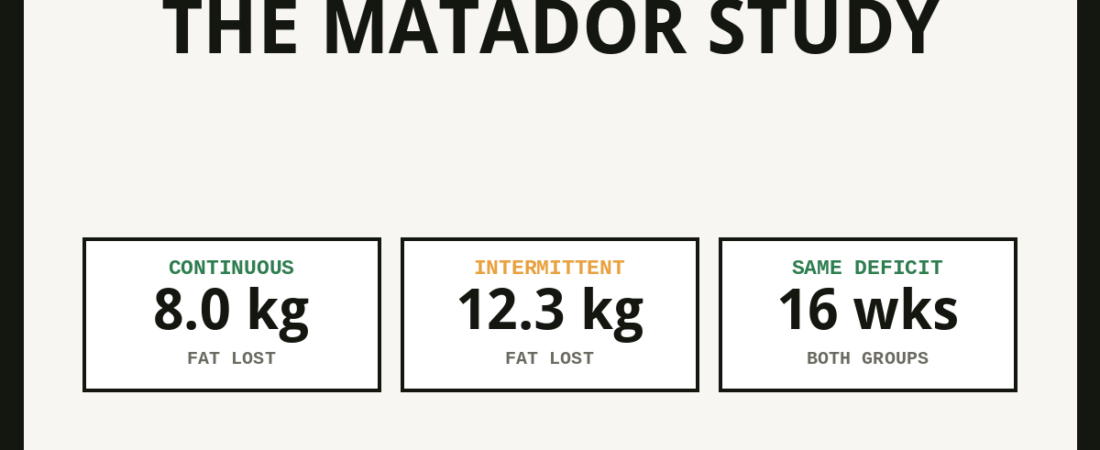
Short answer: the MATADOR study, published by Byrne and colleagues in 2018, compared 16 weeks of continuous calorie restriction against 30 weeks of alternating two-week diet and two-week maintenance blocks, matched for total energy deficit. The intermittent group lost more fat, kept more of it off, and showed less reduction in resting energy expenditure.
Check whether you are due a diet break.
What the study did
MATADOR stands for Minimising Adaptive Thermogenesis And Deactivating Obesity Rebound. Fifty-one men with obesity were randomised to one of two groups, both eating at a 33 percent energy deficit for a total of 16 weeks of actual dieting.
- Continuous group: 16 weeks straight at the deficit.
- Intermittent group: alternating two weeks at the deficit and two weeks at maintenance, taking 30 weeks in total to accumulate the same 16 weeks of restriction.
Crucially, both groups completed the same amount of dieting. The comparison was about how that dieting was distributed, not how much of it there was.
The results
| Outcome | Continuous | Intermittent |
|---|---|---|
| Weight lost | About 9.1 kg | About 14.1 kg |
| Fat lost | About 8.0 kg | About 12.3 kg |
| Reduction in resting energy expenditure | Larger | Smaller |
| Weight kept off at 6 month follow-up | Less | More |
The intermittent group lost substantially more fat despite identical total restriction, and the difference persisted at follow-up.
The proposed explanation
Adaptive thermogenesis. Prolonged energy restriction reduces energy expenditure beyond what the smaller body predicts, driven by lower non-exercise activity and hormonal changes. Periodic maintenance blocks appear to blunt that adaptation, so the deficit stays effective for longer. More on adaptive thermogenesis.
Why to hold it loosely
This is the part most summaries skip. MATADOR is one well-designed study, and several things limit how far it generalises:
- Participants were men with obesity. Extrapolating to lean, trained individuals is not straightforward.
- The deficit was aggressive at 33 percent, which may amplify adaptive effects that a moderate deficit would produce less of.
- Sample size was modest at 51 participants, with dropout.
- Replication is limited. Subsequent work has been mixed, and the effect size here is larger than most researchers would expect to hold up.
The sensible reading: diet breaks are low risk, have plausible mechanisms and one supportive well-designed trial, plus consistent reports of better adherence. That is enough to justify using them. It is not enough to treat the MATADOR effect size as what you should expect.
Applying it
The protocol used two weeks on, two weeks off. Common practice adapts this to a shorter break of one to two weeks after eight to twelve weeks of dieting, which is less disruptive to a timeline. How to run a diet break properly.
FAQ
What was the MATADOR study?
A 2018 randomised trial comparing continuous with intermittent energy restriction, matched for total deficit, in men with obesity.
What did it find?
The intermittent group lost more fat, retained more of the loss at follow-up, and showed less reduction in resting energy expenditure.
Does it apply to lean people?
Uncertain. Participants had obesity and used an aggressive deficit. Extrapolation to lean trainees is not established.
Should I take diet breaks because of it?
They are low risk with plausible mechanisms and adherence benefits. Expect smaller effects than MATADOR reported.
Sources
- Byrne NM, Sainsbury A, King NA, Hills AP, Wood RE. Intermittent energy restriction improves weight loss efficiency in obese men: the MATADOR study. International Journal of Obesity, 2018.
- Peos JJ, Norton LE, Helms ER, Galpin AJ, Fournier P. Intermittent Dieting: Theoretical Considerations for the Athlete. Sports, 2019.
- Trexler ET, Smith-Ryan AE, Norton LE. Metabolic adaptation to weight loss: implications for the athlete. JISSN, 2014.
General information, not medical advice.
Part of The Research — studies and position stands explained plainly.
GramGoal Team. We build nutrition calculators and price-check the supplement market monthly. General information, not medical advice. See our methodology and affiliate disclosure.