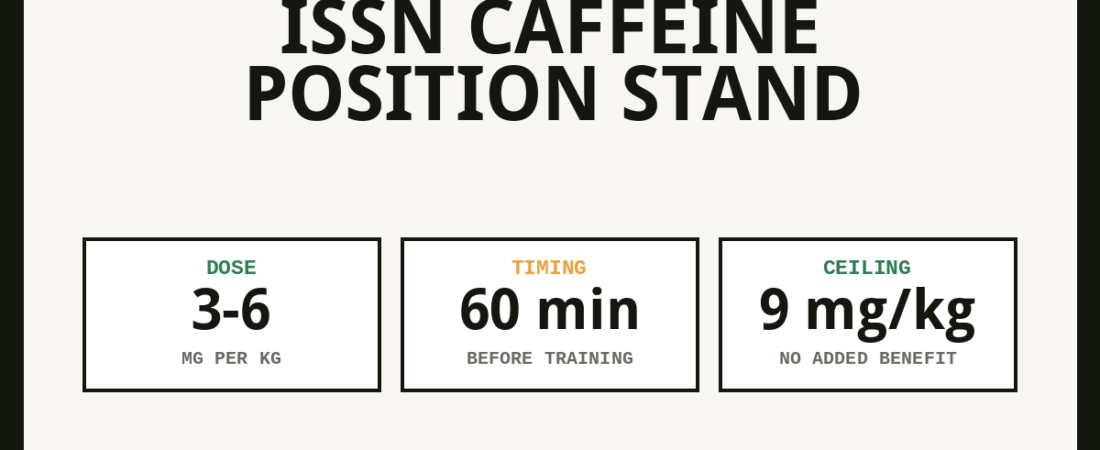
Short answer: the ISSN caffeine position stand, published in 2021, concludes that 3 to 6 mg of caffeine per kilogram of bodyweight improves endurance, muscular endurance, reaction time and perceived exertion, taken roughly 60 minutes before exercise. Doses above about 9 mg/kg raise side effects without adding benefit.
Apply the range to your bodyweight.
What the stand concludes
- Dose: 3 to 6 mg per kg bodyweight. Low doses of around 2 mg/kg can still improve alertness and reaction time.
- Timing: roughly 60 minutes before exercise for capsules or powder, matching peak blood concentration.
- Endurance: the strongest and most consistent evidence, across cycling, running and time-trial protocols.
- Strength and power: benefits exist but are smaller and less consistent than for endurance.
- Form: anhydrous caffeine, capsules and coffee all work. Gum absorbs faster.
- Genetics: CYP1A2 and ADORA2A variants influence response. Some individuals gain little or feel worse.
- Habituation: regular consumers still benefit. Withdrawal before an event is not required.
Dose by bodyweight
| Bodyweight | 3 mg/kg | 6 mg/kg | 9 mg/kg (ceiling) |
|---|---|---|---|
| 55 kg | 165 mg | 330 mg | 495 mg |
| 70 kg | 210 mg | 420 mg | 630 mg |
| 85 kg | 255 mg | 510 mg | 765 mg |
| 100 kg | 300 mg | 600 mg | 900 mg |
Note the collision with general safety guidance: most health authorities cite 400 mg daily as a reasonable ceiling for healthy adults, which anyone above roughly 67 kg reaches at 6 mg/kg from a single pre-workout dose.
What it does not claim
The stand is careful about several things the supplement industry is not. It does not claim meaningful fat loss effects. It does not support the idea that tolerance eliminates performance benefit. And it explicitly notes that individual response varies enough that some people should not use it before competition.
Who wrote it and the funding question
The lead author is Nanci Guest, with a panel of sports nutrition researchers. As with other ISSN stands, some authors have industry relationships, disclosed in the publication. The conclusions align broadly with independent work, including Grgic and colleagues umbrella review in the British Journal of Sports Medicine, which is a reasonable check.
FAQ
What does the ISSN recommend for caffeine?
3 to 6 mg per kg bodyweight, about 60 minutes before exercise.
Is 400 mg of caffeine safe?
Health authorities generally cite 400 mg daily as reasonable for healthy adults. The performance range can exceed this for larger individuals, which is a reason to stay nearer the lower end.
Does caffeine tolerance remove the benefit?
The stand concludes habitual users still benefit. Withdrawal before competition is not required.
Which form of caffeine is best?
Anhydrous caffeine, capsules and coffee are all effective. Gum absorbs faster through the oral mucosa.
Sources
- Guest NS et al. International society of sports nutrition position stand: caffeine and exercise performance. Journal of the International Society of Sports Nutrition, 2021.
- Grgic J et al. Wake up and smell the coffee: caffeine supplementation and exercise performance, an umbrella review. British Journal of Sports Medicine, 2020.
- EFSA Panel on Dietetic Products. Scientific Opinion on the safety of caffeine. EFSA Journal, 2015.
- US Food and Drug Administration. Spilling the Beans: How Much Caffeine is Too Much. fda.gov
General information, not medical advice.
Part of The Research — studies and position stands explained plainly.
GramGoal Team. We build nutrition calculators and price-check the supplement market monthly. General information, not medical advice. See our methodology and affiliate disclosure.