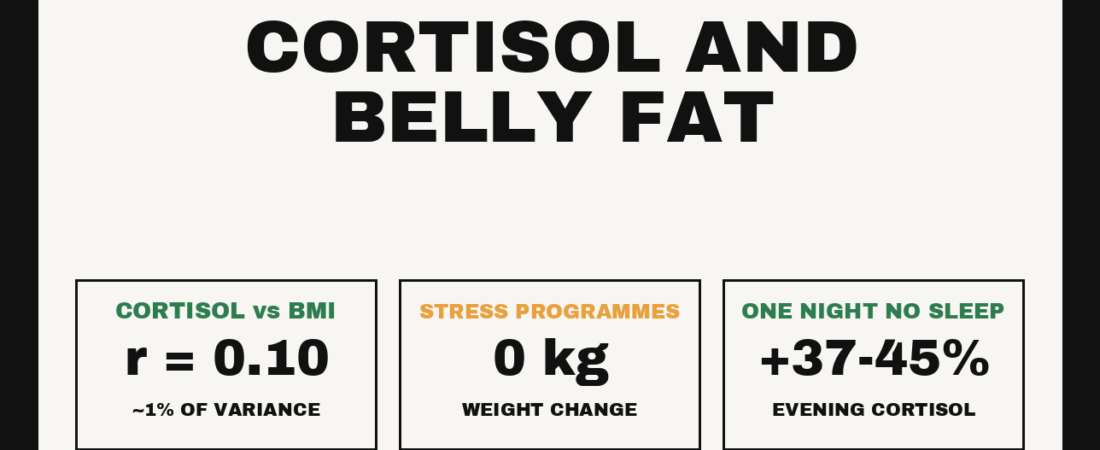
Short answer: cortisol is real physiology, but it is a weak explanation for body fat. In the largest study of long-term cortisol exposure, covering 2,527 adults, the correlation between hair cortisol and BMI was 0.10, which accounts for about one percent of the differences in body size between people. Stress-management programmes do lower cortisol slightly, and separately they do not change weight or BMI. Nobody has demonstrated the link in between.
Cortisol belly, cortisol face and cortisol detox are marketing terms rather than findings. That does not make cortisol irrelevant, and it does not mean stress has nothing to do with body weight. It means the hormone is doing much less of the work than the internet suggests.
How strong is the association?
Start with the biggest dataset. Jackson and colleagues measured hair cortisol, which captures months of exposure rather than a single moment, in 2,527 men and women aged 54 to 87 from the English Longitudinal Study of Ageing. Every association was statistically significant and every one was tiny.
| Measure | Correlation | Variance explained |
|---|---|---|
| Body weight | 0.102 | About 1% |
| BMI | 0.101 | About 1% |
| Waist circumference | 0.082 | Under 1% |
A correlation of 0.10 reached significance because the sample was large, not because the effect was meaningful. It explains roughly one percent of why one person is bigger than another. That is not something visible in an individual, and it cannot carry the claim that cortisol is why you have belly fat.
The study usually cited for the opposite view is Epel and colleagues, who found that women with a high waist-to-hip ratio secreted more cortisol under laboratory stress and, unlike the low-ratio group, failed to habituate over repeated sessions. It is a real finding worth knowing. It is also cross-sectional, in 59 premenopausal women, and it tracked no fat over time. The authors’ own conclusion was that stress-induced cortisol may contribute to central fat. Reverse causation stays open: carrying more abdominal fat may itself alter how reactive the stress axis is. Work out your waist-to-hip ratio.
Larger syntheses land in the middle and lean sceptical. A systematic review of 34 studies rated the evidence on cortisol awakening response and diurnal slope as low quality and contradictory, while finding one consistent signal: more abdominal fat goes with greater stress-axis responsiveness. A separate meta-analysis of 26 studies in 1,511 people found no correlation between obesity and circulating cortisol at all.
Does lowering cortisol cause fat loss?
This is the claim the whole category rests on, and it is the weakest part of it.
- Interventions do lower cortisol, slightly. A 2024 meta-analysis of 58 randomised trials in 3,508 people found a small pooled reduction (Hedges g 0.282). Mindfulness and relaxation carried the effect; talking therapies and mind-body therapies were not significant on their own.
- Interventions do not lower body weight. A 2023 systematic review of mindfulness-based interventions found stress reduced modestly for the first three months, and no meaningful reduction in weight or BMI at any timepoint.
- The one trial that tested the whole chain found nothing. Overweight and obese women were randomised to a mindfulness programme aimed squarely at reducing cortisol and abdominal fat. Groups did not differ on average cortisol awakening response, weight, or abdominal fat. The authors labelled it exploratory.
The first link exists and is small. The last link does not appear at all. No study has joined them.
What actually moves cortisol
Plenty of ordinary things do, which is rather the point. Cortisol rising on waking, during hard exercise and under acute stress is normal function, not damage.
| Exposure | Effect on cortisol |
|---|---|
| One night of sleep loss | Evening cortisol 37 to 45% higher next day |
| 1200 kcal/day for three weeks | Total output up, Cohen d 0.63 |
| 30 min exercise at 40% VO2 max | +5.7% |
| 30 min at 60% VO2 max | +39.9% |
| 30 min at 80% VO2 max | +83.1% |
| Caffeine, after five days of daily intake | Morning response abolished, afternoon response persists |
Two rows deserve a second look. Severe calorie restriction raising cortisol is a genuine finding and one more reason aggressive deficits get abandoned; see diet breaks and the calorie deficit calculator for a more sustainable rate. And the exercise rows describe a normal training signal, not a reason to avoid hard sessions. Note also that the caffeine response blunts with habitual intake but does not disappear. Check your caffeine load.
The cortisol face question
There is no published evidence that normal-range cortisol causes facial puffiness. Searching the literature for cortisol face returns consumer media and nothing else: no primary study, no review, no statement from any clinical body.
Facial rounding, or moon facies, is a sign of sustained pathological glucocorticoid excess, from steroid medication or a pituitary or adrenal tumour. The Endocrine Society’s guideline notes that few features of Cushing’s syndrome are unique, and that the discriminating ones are purple striae, facial plethora, proximal muscle weakness, unexplained bruising and unexplained osteoporosis. Facial fullness is listed among the common but non-discriminatory features, precisely because it is common in the general population.
Hypercortisolism without a tumour does exist, but the recognised causes are conditions like alcohol use disorder, advanced kidney disease, poorly controlled diabetes, pregnancy and obstructive sleep apnoea. A demanding job is not on that list.
Everyday facial puffiness has mundane explanations that nobody has shown to be cortisol-mediated: sodium, alcohol, sleep position, fluid shifts, weight change, allergy. Persistent unexplained changes are a reason to see a doctor rather than to self-diagnose from a checklist.
What to do with all this
Stress does relate to body weight. The pathway with the best support is behavioural rather than hormonal: stress degrades self-regulation, shifts eating toward higher-calorie food, reduces activity and shortens sleep. Those are the levers, and sleep has the clearest evidence of the set. Beyond that, energy balance still decides the outcome.
One thing not to do: order a cortisol test to explain your weight. The Endocrine Society explicitly recommends against widespread testing outside specific clinical situations, and a single value means little given how much cortisol varies by assay and time of day.
FAQ
Does cortisol cause belly fat?
The measured association is weak, around 0.10 in the largest study, and the direction of causation is unresolved. Abdominal fat may drive stress-axis reactivity as much as the reverse.
How do I lower cortisol?
Sleep enough, keep caffeine away from the evening, avoid extreme deficits, and use mindfulness or relaxation practices if you like them. Pooled effects on cortisol are real but small.
Is cortisol face real?
Not at normal cortisol levels. Moon facies is a feature of genuine glucocorticoid excess, which is a medical condition, not a consequence of a stressful week.
What is a cortisol detox?
Not a defined intervention. There is no protocol behind the phrase and no trial testing one.
Does high cortisol stop weight loss?
No trial shows that lowering cortisol produces weight loss, and interventions that reliably lower it produce no weight change. If loss has stalled, adaptation and intake drift are the more likely explanations.
Sources
- Jackson SE, Kirschbaum C, Steptoe A. Hair cortisol and adiposity in a population-based sample of 2,527 men and women aged 54 to 87 years. Obesity, 2017;25(3):539-544.
- Epel ES, McEwen B, Seeman T, et al. Stress and body shape: stress-induced cortisol secretion is consistently greater among women with central fat. Psychosomatic Medicine, 2000;62(5):623-632.
- Incollingo Rodriguez AC, Epel ES, White ML, et al. Hypothalamic-pituitary-adrenal axis dysregulation and cortisol activity in obesity: a systematic review. Psychoneuroendocrinology, 2015;62:301-318.
- Tenk J, Matrai P, Hegyi P, et al. In obesity, HPA axis activity does not increase with BMI, but declines with aging: a meta-analysis of clinical studies. PLOS ONE, 2016;11(11):e0166842.
- Rogerson O, Wilding S, Prudenzi A, O’Connor DB. Effectiveness of stress management interventions to change cortisol levels: a systematic review and meta-analysis. Psychoneuroendocrinology, 2024;159:106415.
- Sosa-Cordobes E, Ramos-Pichardo JD, Sanchez-Ramos JL, et al. How effective are mindfulness-based interventions for reducing stress and weight? A systematic review and meta-analysis. International Journal of Environmental Research and Public Health, 2023;20(1):446.
- Daubenmier J, Kristeller J, Hecht FM, et al. Mindfulness intervention for stress eating to reduce cortisol and abdominal fat among overweight and obese women: an exploratory randomized controlled study. Journal of Obesity, 2011;2011:651936.
- Leproult R, Copinschi G, Buxton O, Van Cauter E. Sleep loss results in an elevation of cortisol levels the next evening. Sleep, 1997;20(10):865-870.
- Tomiyama AJ, Mann T, Vinas D, et al. Low calorie dieting increases cortisol. Psychosomatic Medicine, 2010;72(4):357-364.
- Hill EE, Zack E, Battaglini C, et al. Exercise and circulating cortisol levels: the intensity threshold effect. Journal of Endocrinological Investigation, 2008;31(7):587-591.
- Lovallo WR, Whitsett TL, al’Absi M, et al. Caffeine stimulation of cortisol secretion across the waking hours in relation to caffeine intake levels. Psychosomatic Medicine, 2005;67(5):734-739.
- Nieman LK, Biller BMK, Findling JW, et al. The diagnosis of Cushing’s syndrome: an Endocrine Society clinical practice guideline. Journal of Clinical Endocrinology and Metabolism, 2008;93(5):1526-1540.
- Findling JW, Raff H. Recognition of nonneoplastic hypercortisolism in the evaluation of patients with Cushing syndrome. Journal of the Endocrine Society, 2023;7(8):bvad087.
- Tomiyama AJ. Stress and obesity. Annual Review of Psychology, 2019;70:703-718.
General information, not medical advice. This article does not interpret cortisol test results or diagnose any condition. Persistent unexplained changes in weight, skin or strength are a reason to see a doctor.
GramGoal Team. We build nutrition calculators and price-check the supplement market monthly. General information, not medical advice. See our methodology and affiliate disclosure.