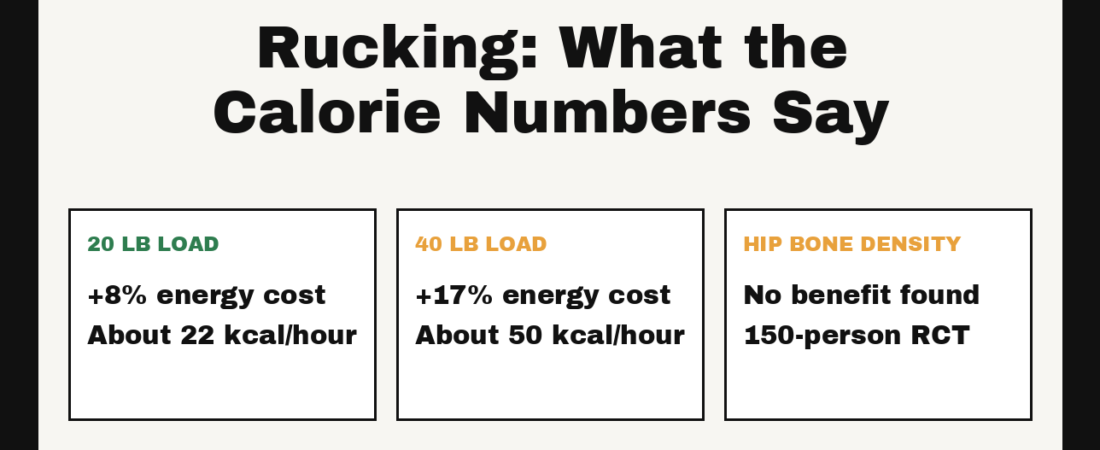
Short answer: adding a pack costs less than people expect. For an 80 kg adult walking at 4.8 km/h on the flat, a 9 kg load (about 20 lb) raises energy cost by roughly 8 percent, and an 18 kg load (about 40 lb) by roughly 17 percent. In real terms that is about 22 and 50 extra calories per hour. The numbers come from load-carriage equations the military has validated for decades, and they are considerably less exciting than the marketing.
Where the numbers come from
Rucking is new as a fitness trend and very old as a research subject. Pandolf, Givoni and Goldman published the standard equation for predicting the metabolic cost of walking with a load in the Journal of Applied Physiology in 1977, and it is still the backbone of military load-carriage planning. It takes body mass, load mass, walking speed, gradient and a terrain factor, and returns metabolic rate in watts.
It has been extended since. Looney and colleagues published a weighted-vest term for the US Army Load Carriage Decision Aid in 2024, built from 20 adults walking under vest loads up to 66 percent of body mass and validated against 12 reference datasets covering 264 participants. Vest-borne loads sit differently than a backpack, which is why the update exists.
What an hour of rucking costs
The table below applies the Pandolf equation to an 80 kg adult walking on level blacktop at 4.8 km/h, which is a brisk but ordinary pace. These are gross figures, meaning they include the resting metabolism you would have burned anyway.
| Load | Metabolic rate | Calories per hour | Extra vs unloaded |
|---|---|---|---|
| None | 335 W | 289 kcal | — |
| 9 kg (20 lb) | 362 W | 311 kcal | +22 kcal (+8%) |
| 18 kg (40 lb) | 394 W | 339 kcal | +50 kcal (+17%) |
| 27 kg (60 lb) | 433 W | 372 kcal | +84 kcal (+29%) |
Read the last column honestly. An hour under 40 lb buys you about 50 calories over the same hour of plain walking, which is about half a banana. The cost curve does steepen as loads get heavy, because the penalty scales with the square of the load-to-bodyweight ratio, but you reach genuinely unpleasant loads before you reach impressive numbers.
Walking faster does more than loading heavier. At 5.6 km/h the same 80 kg adult burns about 355 kcal per hour unloaded, more than the 20 lb ruck at the slower pace. If the goal is calories, pace is the cheaper lever. Our calories burned calculator and steps to calories calculator cover the unloaded case, and walking for weight loss covers what those numbers mean over a week.
How accurate are the equations?
Reasonable, within limits. Vine and colleagues tested five prediction equations against measured oxygen consumption in 39 infantry soldiers carrying 25 to 70 kg at two walking speeds. Four of the five equations underpredicted metabolic cost across the board. Pandolf’s held up best at moderate loads and speeds but overpredicted at 60 and 70 kg at the faster pace and underpredicted at the slower one.
Treat the table as a good estimate at ordinary recreational loads and a rough one at the extremes.
The bone density claim does not hold up
The most repeated argument for weighted walking is that the extra load protects bone. The best test of that idea did not find it.
The INVEST trial, published in JAMA Network Open in 2025, randomised 150 older adults with obesity to 12 months of weight loss alone, weight loss plus a weighted vest worn about seven hours a day, or weight loss plus supervised resistance training three times a week. All three groups lost a similar 9 to 11 percent of body weight. All three lost hip trabecular bone density, by 1.2 to 1.9 percent, with no significant difference between the vest group and weight loss alone. The authors concluded that neither the vest nor resistance training was able to offset weight-loss-associated bone loss at the hip.
That is a well-run, year-long trial with a clear negative result, and it deserves more attention than it gets.
One intriguing but very small signal
A pilot follow-up of 18 older adults reported something worth flagging carefully. Both groups lost similar weight by six months, about 11 kg with a vest and 10 kg without. By 24 months the vest group had regained roughly half of it and the other group had regained all of it, and resting metabolic rate had fallen by about 238 kcal per day without the vest while barely moving with it.
Eighteen people, a convenience sample, and a difference that did not reach significance. A hypothesis, not a finding, though it sits neatly alongside what we know about metabolic adaptation.
Load carriage has a real injury cost
Military load-carriage research is as much about injury as energy. An international review led by Orr in 2021 catalogues foot, knee, back and shoulder problems plus nerve compression syndromes distinctive enough to have their own names, such as rucksack palsy. Those come from heavy loads carried far, not a 20 lb pack round the block, but the direction of the risk is clear and progression should be slow.
Where the evidence is thin
Nearly all load-carriage data comes from military populations, which skew young, male and fit, carrying loads far heavier than any recreational rucker. No long-term trial has compared recreational rucking with ordinary brisk walking. The calorie figures above are model estimates, not measurements of you. The honest summary: a pleasant way to make a walk harder, with one negative trial against its most-cited benefit.
FAQ
How many calories does rucking burn?
For an 80 kg adult walking an hour at 4.8 km/h on the flat, about 311 kcal with 20 lb and about 339 kcal with 40 lb, against 289 kcal unloaded. Heavier bodies, faster paces and hills all push those numbers up.
What is rucking?
Walking with weight on your back or torso, usually in a backpack or a vest. The term comes from military rucksack marches, where it is a graded, tested skill rather than a workout.
How much weight should you ruck with?
There is no evidence-based recreational standard. What the research does show is that energy cost rises with the square of the load relative to your bodyweight, and that injury risk in military populations tracks load and distance. Starting light and adding slowly is the conclusion those two facts point at.
Is rucking better than walking?
It burns modestly more per hour and loads the shoulders, back and legs more. Nobody has run the trial comparing the two over months. If you enjoy it, that beats a walk you skip.
Does rucking build muscle?
Not meaningfully in anyone already active. It is sustained low-intensity work, closer to zone 2 cardio than to resistance training, and the loads involved are far below what drives growth.
Sources
- Pandolf KB, Givoni B, Goldman RF. Predicting energy expenditure with loads while standing or walking very slowly. Journal of Applied Physiology. 1977;43(4):577-581.
- Looney DP, Lavoie EM, Notley SR, et al. Metabolic costs of walking with weighted vests. Medicine and Science in Sports and Exercise. 2024;56(6):1177-1185.
- Vine CA, Coakley SL, Blacker SD, et al. Accuracy of metabolic cost predictive equations during military load carriage. Journal of Strength and Conditioning Research. 2022;36(5):1297-1303.
- Beavers KM, Lynch SD, Fanning J, et al. Weighted vest use or resistance exercise to offset weight loss-associated bone loss in older adults: a randomized clinical trial. JAMA Network Open. 2025;8(6):e2516772.
- DeLong C, Nicklas BJ, Beavers DP, Fanning J, Beavers KM. Does weighted vest use during weight loss influence long-term weight loss maintenance? A pilot study in older adults living with obesity and osteoarthritis. International Journal of Obesity. 2025;49(8):1662-1665.
- Orr R, Pope R, Lopes TJA, et al. Soldier load carriage, injuries, rehabilitation and physical conditioning: an international approach. International Journal of Environmental Research and Public Health. 2021;18(8):4010.
GramGoal Team. We build nutrition calculators and price-check the supplement market monthly. General information, not medical advice. See our methodology and affiliate disclosure.