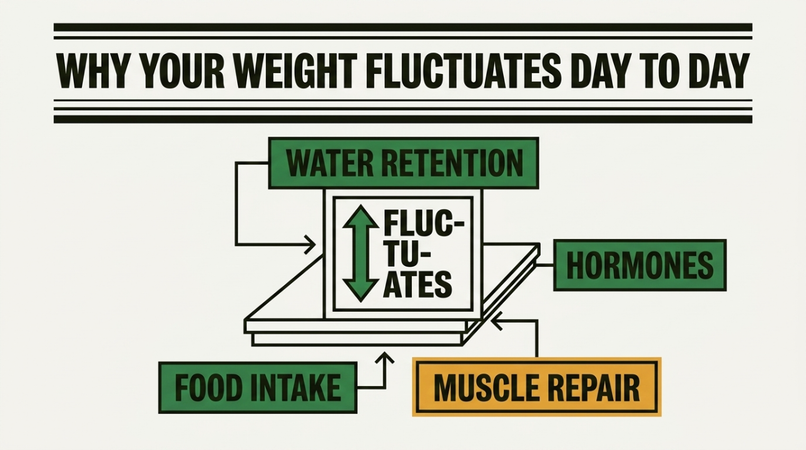
Short answer: daily weight swings of one to two kilograms are normal and are almost never fat. Water, glycogen, sodium, food volume in your digestive tract, hormones and bowel timing all move the number. Fat gain or loss happens far too slowly to explain what you see morning to morning.
See what a realistic rate of change looks like.
What actually moves the scale
| Cause | Typical swing | How fast |
|---|---|---|
| Food and fluid in transit | 0.5-2 kg | Hours |
| Glycogen and bound water | 0.5-2 kg | 1-3 days |
| Sodium and water retention | 0.5-1.5 kg | 1-2 days |
| Menstrual cycle | 0.5-2 kg | Cyclical |
| Cortisol from stress or poor sleep | 0.5-1 kg | Days |
| Training-induced inflammation | 0.5-1 kg | 1-3 days |
| Actual fat change | About 0.1 kg per day at most | Weeks |
The bottom row is the point. Losing half a kilogram of fat requires roughly a 3,850 calorie deficit. If the scale drops two kilograms overnight, you did not lose two kilograms of fat, because that would require a deficit larger than most people eat in a week.
The glycogen and water link
Every gram of stored glycogen holds roughly three grams of water. Full glycogen stores hold around 400 to 500 g of carbohydrate plus over a kilogram of associated water.
This explains three common experiences. The dramatic first week of a low carbohydrate diet is mostly glycogen and water. The jump after a high carbohydrate meal is the same process reversed. And the rise during a diet break is glycogen refilling, not fat regain. More on diet breaks.
How to weigh yourself usefully
- Same conditions every time. Morning, after the toilet, before eating or drinking, minimal clothing.
- Weigh daily, judge weekly. A single reading is noise. A seven-day average is signal.
- Compare week to week, not day to day.
- Give it three weeks before concluding anything about your calorie target.
- Track something else too. Waist measurement changes more slowly and lies less. Waist to height.
Weekly averages work because the noise is random and averages cancel it out, while the trend persists.
Why women see larger swings
Fluid retention varies across the menstrual cycle, commonly peaking in the late luteal phase before menstruation, with swings of a kilogram or more that have nothing to do with fat. The practical approach is comparing the same phase month to month rather than week to week.
When a plateau is real
A genuine plateau is three or more weeks with no change in the weekly average while adherence is unchanged. Anything shorter is normal variation. When it is real, the usual causes are:
- Intake has crept up. Portion drift is gradual and invisible without tracking.
- Your maintenance has fallen because you are lighter. Recalculate it.
- Non-exercise activity has dropped, which happens quietly during a deficit.
- Water retention is masking fat loss, common with high stress or a new training programme.
FAQ
Why did I gain 2 kg overnight?
Food volume, sodium and water. Two kilograms of fat requires roughly a 15,000 calorie surplus, which is not possible overnight.
Should I weigh myself daily?
Yes, but judge by the weekly average. Daily weighing gives more data points and makes the trend clearer, provided you ignore individual readings.
Why do I weigh more after training?
Inflammation and fluid retention in repairing muscle, plus rehydration. It settles within a few days.
How long before a plateau is real?
Three weeks of no change in the weekly average, with adherence unchanged.
Sources
- Hall KD et al. Quantification of the effect of energy imbalance on bodyweight. The Lancet, 2011.
- Olsson KE, Saltin B. Variation in total body water with muscle glycogen changes in man. Acta Physiologica Scandinavica, 1970.
- Bhutani S et al. Composition of two-week change in body weight under unrestricted free-living conditions. Physiological Reports, 2017.
- Stachenfeld NS. Sex hormone effects on body fluid regulation. Exercise and Sport Sciences Reviews, 2008.
General information, not medical advice. Rapid unexplained weight change warrants medical assessment.
GramGoal Team. We build nutrition calculators and price-check the supplement market monthly. General information, not medical advice. See our methodology and affiliate disclosure.