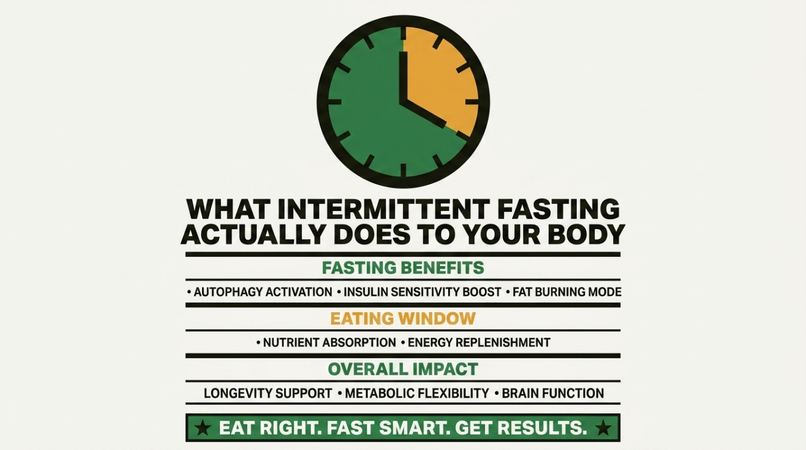
Short answer: intermittent fasting works for weight loss when it makes you eat less, and trials comparing it against continuous calorie restriction at matched intake generally find similar results. The physiological changes people describe are real but smaller and slower than the marketing suggests. It is an eating schedule, not a metabolic switch.
Set your calorie target first, because that is what determines whether any schedule works.
What happens hour by hour
| Time since last meal | What the body is doing |
|---|---|
| 0-4 hours | Digesting and absorbing. Insulin elevated, glucose the main fuel. |
| 4-12 hours | Insulin falls, liver glycogen supplies glucose. Fat oxidation rises gradually. |
| 12-18 hours | Liver glycogen depleting, fat becomes a larger share of fuel. Ketone production begins to rise. |
| 18-24 hours | Ketones rise further. Growth hormone elevated. Autophagy markers increase in animal research. |
| 24-48 hours | Deeper ketosis. Human evidence for benefits here is limited and the practical cost is high. |
This sequence is real, and it is also what happens to anyone who skips breakfast. The question is not whether these shifts occur but whether they produce outcomes beyond eating fewer calories.
What the trials show
- Weight loss. Effective, and generally equivalent to continuous restriction when calories are matched. Reviews consistently find no meaningful advantage for fasting per se.
- Insulin sensitivity. Some trials report improvements, often alongside weight loss, which makes it hard to separate the schedule from the loss itself.
- Muscle retention. A genuine concern. Compressing eating into a short window makes hitting protein targets harder, and some studies find greater lean mass loss with fasting protocols.
- Autophagy. The most oversold claim. Most evidence is from animal and cell studies, with human data limited and the fasting durations required unclear.
- Longevity. Extensively studied in animals, not established in humans.
The protocols
- 16:8. Eight hour eating window daily. The most sustainable and most studied.
- 5:2. Two days weekly at around 500 to 600 calories. Effective for some, difficult for others.
- Alternate day fasting. Higher dropout rates in trials.
- OMAD. One meal daily. Hitting protein and micronutrient targets in a single sitting is genuinely difficult.
The protein problem
This is the practical issue that gets least attention. If your target is 150 g of protein and you have an eight hour window, that is three meals of 50 g. Achievable, but it requires planning. In a four hour window it becomes hard, and in one meal it is close to impossible without supplements.
Muscle protein synthesis is also stimulated per feeding rather than per day, so fewer feedings means fewer stimulation events. Per-meal protein targets.
Who it suits and who it does not
Suits: people who naturally skip breakfast, prefer fewer larger meals, find calorie counting tedious, or want simpler decision-making.
Does not suit: people prioritising muscle gain, anyone with a history of disordered eating, people with diabetes on glucose-lowering medication without medical supervision, pregnancy, and people who become irritable or unproductive when hungry.
On that third group: fasting while on insulin or sulfonylureas carries hypoglycaemia risk and is a medical conversation, not a lifestyle choice.
FAQ
What does intermittent fasting do to your body?
Insulin falls, glycogen depletes, fat oxidation and ketone production rise gradually. These are normal responses to not eating rather than unique effects.
Is intermittent fasting better than counting calories?
Not physiologically. Trials at matched calories find similar results. It is better if it helps you eat less consistently.
Does fasting burn more fat?
You use a higher proportion of fat while fasted, but total fat loss over weeks depends on the calorie deficit, not the timing.
Will I lose muscle?
Possible if protein intake falls or resistance training stops. Both are manageable with planning.
Sources
- Lowe DA et al. Effects of Time-Restricted Eating on Weight Loss and Other Metabolic Parameters. JAMA Internal Medicine, 2020.
- Trepanowski JF et al. Effect of Alternate-Day Fasting on Weight Loss, Weight Maintenance, and Cardioprotection. JAMA Internal Medicine, 2017.
- de Cabo R, Mattson MP. Effects of Intermittent Fasting on Health, Aging, and Disease. New England Journal of Medicine, 2019.
- National Institute of Diabetes and Digestive and Kidney Diseases. Intermittent fasting research overview. niddk.nih.gov
- Tinsley GM, La Bounty PM. Effects of intermittent fasting on body composition and clinical health markers. Nutrition Reviews, 2015.
General information, not medical advice. Fasting is not appropriate for everyone, particularly with diabetes medication, pregnancy or a history of disordered eating.
Plan your eating window and check the protein fits.
GramGoal Team. We build nutrition calculators and price-check the supplement market monthly. General information, not medical advice. See our methodology and affiliate disclosure.