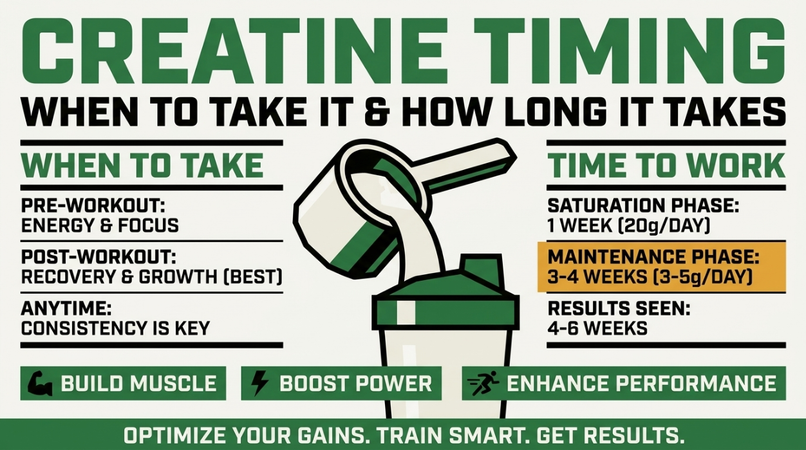
Short answer: creatine timing barely matters, and the question people usually mean is how long until it works. Muscle stores saturate in about a week with loading or three to four weeks at 3 to 5 g daily. Once saturated, the time of day you take it makes no meaningful difference. Consistency is the entire mechanism.
Get your dose or see dose plus fluid targets.
Why timing matters so little
Creatine does not work acutely the way caffeine does. It works by raising the amount of phosphocreatine stored in muscle, and that store is either saturated or it is not. Taking your daily dose at 8am or 8pm does not change the saturation level; missing doses for a week does.
This is the opposite of how most supplements are marketed, and it is why pre-workout blends including creatine are slightly beside the point. The creatine in your pre-workout is contributing to saturation, not fuelling that session.
How long until it works
| Protocol | Daily dose | Time to saturation | Notes |
|---|---|---|---|
| Loading | 0.3 g per kg, split into 4 | 5 to 7 days | More digestive complaints |
| Steady | 3 to 5 g | 3 to 4 weeks | Same endpoint, fewer complaints |
| Low dose | 2 g | Longer, may not fully saturate | Not recommended |
Both routes end in the same place. Loading buys speed and nothing else, which is worth knowing before you buy a product that markets a loading protocol as essential. Full comparison.
What you notice, and when
- Week 1: scale weight up 1 to 2 kg with loading, less with steady dosing. That is intracellular water, not muscle.
- Weeks 2 to 4: some people notice an extra rep or two on higher-intensity sets. Others notice nothing subjectively.
- Weeks 4 to 12: where measurable strength and lean mass differences show up in trials, always alongside training.
- Never: if you are not training. Creatine supports work; it does not replace it.
The evidence on timing that does exist
A small number of studies have compared taking creatine before versus after training, with some reporting a modest advantage for post-workout. The effects are small, the studies few, and the findings not consistently replicated. Position stands do not make a timing recommendation on this basis.
Taking creatine with a meal containing carbohydrate and protein may slightly improve muscle uptake through an insulin-mediated mechanism. This is real but marginal, and it does not change the endpoint once you are saturated. If it is convenient, do it; if not, do not worry about it.
Rest days, breaks and cycling
- Take it on rest days. The goal is maintaining saturation, not fuelling a session. Skipping rest days slowly drains stores.
- Cycling is unnecessary. No evidence supports on-off cycles, and your body does not downregulate its own production permanently.
- If you stop, stores decline over roughly four to six weeks and return to baseline. Any water weight goes with them.
- Restarting means going through saturation again, which is another argument for consistency over cycling.
Non-responders
Around 20 to 30 percent of people see little response, and the usual explanation is a high baseline. People who eat a lot of red meat and fish already carry substantial muscle creatine, leaving less room to top up. Vegetarians and vegans, who have the lowest dietary intake, tend to show the largest responses.
If you have taken 5 g daily for eight weeks alongside consistent training and noticed nothing at all, you may simply be near your ceiling. That is not a reason to take more; excess creatine is excreted.
Practical protocol
- 3 to 5 g of creatine monohydrate daily, every day.
- Any time that helps you remember. With a meal if it upsets your stomach.
- Dissolve in 250 to 350 ml of warm liquid, and do not leave it standing.
- Skip loading unless you have a specific reason to saturate fast.
- Give it eight to twelve weeks alongside progressive training before judging.
FAQ
When should I take creatine?
Any time of day. Daily consistency is what saturates muscle, not timing.
How long does creatine take to work?
Roughly one week with loading, three to four weeks at 3 to 5 g daily. Measurable strength differences generally appear over four to twelve weeks of training.
Should I take creatine on rest days?
Yes. Maintaining saturation is the point, and stores decline if you skip days.
Why is creatine not working for me?
Common reasons: not enough time, inconsistent dosing, no progressive training, or a high dietary baseline leaving little room to top up.
Sources
- Kreider RB et al. ISSN position stand: safety and efficacy of creatine supplementation. JISSN, 2017.
- Hultman E, Soderlund K, Timmons JA, Cederblad G, Greenhaff PL. Muscle creatine loading in men. Journal of Applied Physiology, 1996.
- Antonio J, Ciccone V. The effects of pre versus post workout supplementation of creatine monohydrate on body composition and strength. JISSN, 2013.
- Burke DG et al. Effect of creatine supplementation and resistance-exercise training on muscle insulin-like growth factor in young adults. IJSNEM, 2008.
- Kerksick CM et al. ISSN Position Stand: nutrient timing. JISSN, 2017.
General information, not medical advice. Discuss creatine with your doctor if you have kidney disease.
GramGoal Team. We build nutrition calculators and price-check the supplement market monthly. General information, not medical advice. See our methodology and affiliate disclosure.