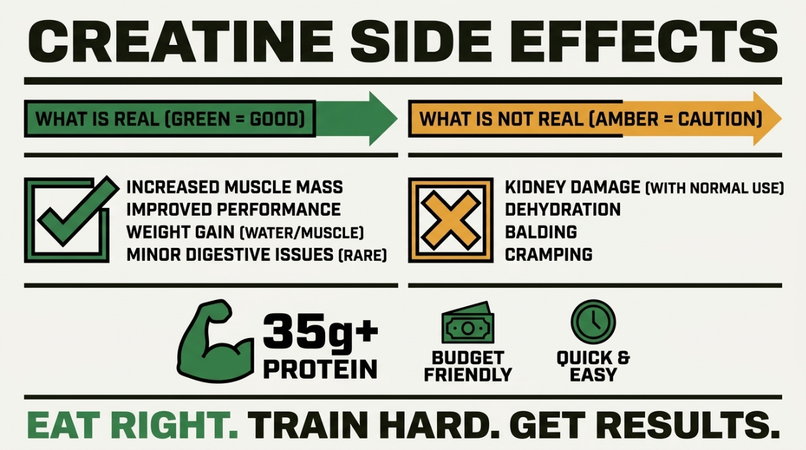
Short answer: creatine monohydrate is among the most-studied supplements in existence, and the safety record in healthy adults is strong. The genuine, documented effects are water weight gain and occasional digestive upset at large single doses. The widely repeated claims about kidney damage, hair loss, dehydration and cramping are either unsupported or rest on a single small study that has never been replicated.
What actually happens
Water weight gain
The most reliable effect. Expect 1 to 2 kg in the first weeks, faster with loading. It is intracellular water inside muscle, not subcutaneous fluid, and it stabilises once stores are saturated. For most people this is a benefit rather than a side effect. If you compete in a weight-category sport, it is worth planning around.
Digestive discomfort
Bloating, cramping or loose stools, almost entirely associated with large single doses during loading. Splitting a 20 g loading dose into four servings, or skipping loading and taking 3 to 5 g daily, resolves it for the large majority of people. Undissolved creatine sitting in the stomach is a common contributor, so mixing properly in warm liquid helps.
The kidney question
This is the most persistent concern and deserves a proper answer. Creatine is metabolised to creatinine, which is excreted by the kidneys and is also the marker used to estimate kidney function. Supplementing creatine raises serum creatinine.
That rise reflects increased creatine turnover, not kidney damage. Studies measuring actual kidney function, including glomerular filtration rate, have not found impairment in healthy individuals at recommended doses, across durations extending to several years.
Two practical implications. First, tell your doctor you take creatine before a blood test, because an unexplained creatinine rise can trigger unnecessary investigation. Second, if you have existing kidney disease, reduced kidney function or take medication affecting the kidneys, this is a conversation with your doctor rather than a decision based on general reassurance.
Hair loss: one study, never replicated
The hair loss claim traces to a single 2009 study in twenty college rugby players, which found an increase in dihydrotestosterone, a hormone associated with male pattern baldness. It did not measure hair loss. No study has since demonstrated that creatine causes hair loss, and subsequent work has generally failed to replicate the DHT finding.
An honest summary: one small study found a hormonal marker moved, that finding has not been reliably reproduced, and the outcome people actually care about has never been shown. If you are already predisposed to male pattern baldness and want to be cautious, that is a reasonable personal choice, but it is not what the evidence currently supports.
Claims that failed testing
- Dehydration. Studies on hydration status found no impairment. Full breakdown.
- Muscle cramps. Reviews found no increase, and some studies reported fewer cramps.
- Heat illness. Research in hot conditions has not supported the concern, with some evidence of improved thermoregulation.
- Liver damage. Not supported at recommended doses in healthy people.
- Compartment syndrome and rhabdomyolysis. Case reports exist, but controlled research has not established a causal link.
Who should be careful
- Existing kidney disease or reduced kidney function. A medical decision, not a general one.
- Medications affecting the kidneys, including some anti-inflammatories used long term.
- Pregnancy and breastfeeding, where evidence is insufficient to make a recommendation.
- Under 18, where research is more limited and use should involve a clinician.
- Weight-category athletes, for practical rather than safety reasons.
Reducing the odds of problems
- Skip loading. 3 to 5 g daily reaches the same saturation in three to four weeks with far fewer digestive complaints.
- Dissolve it properly, in 250 to 350 ml of warm liquid.
- Take it with food if it bothers your stomach on its own.
- Use plain monohydrate from a third-party tested product. Purity and certification explained.
- Do not exceed recommended doses. Extra creatine beyond saturation is excreted, not stored.
The overall picture
Pooled analyses across hundreds of trials have not found a higher rate of adverse events in creatine users than in placebo groups. Long-term studies extending to five years in some populations have not identified harms in healthy individuals. That is an unusually strong safety record for any supplement, and it is why creatine is one of the few the ISSN describes in unambiguously positive terms.
Work out your dose if you decide to take it.
FAQ
Is creatine bad for your kidneys?
Not in healthy people at recommended doses. It raises serum creatinine as a metabolic byproduct, which is not the same as kidney damage. Existing kidney disease changes the answer.
Does creatine cause hair loss?
No study has demonstrated hair loss. The concern comes from one small 2009 study measuring a hormone, not hair, and it has not been reliably replicated.
Is it safe to take creatine long term?
Studies extending to five years in healthy adults have not identified harms at recommended doses.
Should I cycle creatine?
No evidence supports cycling. Consistent daily intake maintains saturation.
Sources
- Kreider RB et al. ISSN position stand: safety and efficacy of creatine supplementation. JISSN, 2017.
- Antonio J et al. Common questions and misconceptions about creatine supplementation: what does the scientific evidence really show? JISSN, 2021.
- de Souza e Silva A et al. Effects of creatine supplementation on renal function. Journal of Renal Nutrition.
- van der Merwe J, Brooks NE, Myburgh KH. Three weeks of creatine monohydrate supplementation affects dihydrotestosterone to testosterone ratio in college-aged rugby players. Clinical Journal of Sport Medicine, 2009.
- Dalbo VJ et al. Putting to rest the myth of creatine supplementation leading to muscle cramps and dehydration. British Journal of Sports Medicine, 2008.
- National Institutes of Health, Office of Dietary Supplements. Dietary Supplements for Exercise and Athletic Performance. ods.od.nih.gov
General information, not medical advice. Speak to your doctor before taking creatine if you have kidney disease, take prescription medication, are pregnant or breastfeeding, or are under 18.
GramGoal Team. We build nutrition calculators and price-check the supplement market monthly. General information, not medical advice. See our methodology and affiliate disclosure.