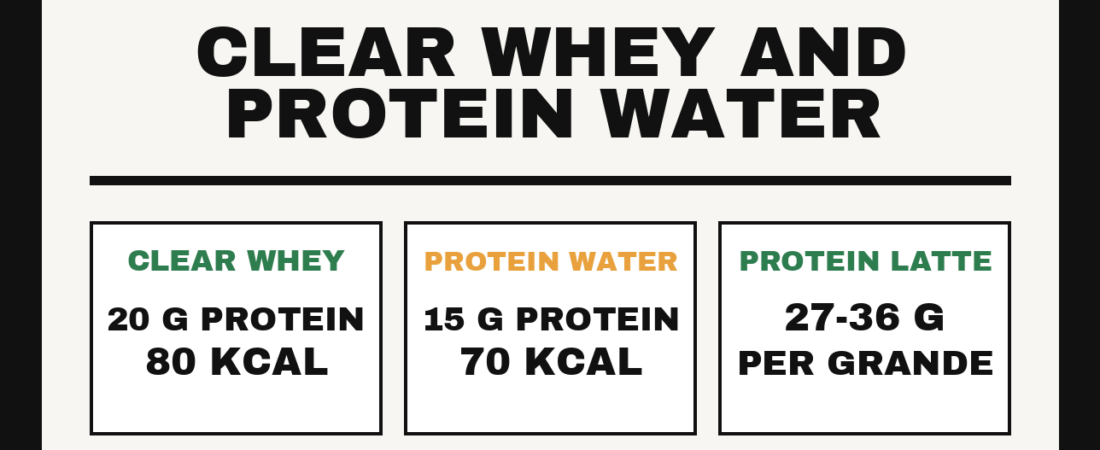
Short answer: clear whey, protein water and the new protein coffees are all built on the same ingredient, whey protein isolate, sometimes hydrolysed. The protein is not different in kind. What changes is the dose. A clear whey scoop delivers about 20 g against 25 g from a standard isolate scoop, a bottled protein water about 15 g, and a protein cold foam 15 to 18 g. They are drinks that happen to contain protein, and they work if the number on the label gets you to your daily target.
This category has grown quickly, and the marketing around it leans on words like absorption, purity and bioavailability that do not survive much scrutiny. Here is what is actually in these products and what the research says about whether the format matters.
What these products actually are
- Clear whey. Whey protein isolate or hydrolysed whey, formulated at low pH so the drink stays translucent and tastes like a cordial rather than a milkshake. Myprotein’s Clear Whey Isolate lists hydrolysed whey protein for most flavours and whey protein isolate for others.
- Protein water. A ready-to-drink bottle of whey isolate plus electrolytes and flavouring. Protein2o lists 15 g of whey protein isolate in a 16.9 fl oz bottle at 70 calories and zero sugar.
- Protein coffee. Starbucks blends whey protein isolate into cold foam or into 2 percent milk. The company lists 15 to 18 g for the cold foam alone, 19 to 26 g for a cold foam beverage, and 27 to 36 g for a protein latte made with protein-boosted milk, all at grande size, with a note that recipes are handcrafted so grams vary.
Nothing there is exotic. Every one of them is whey isolate in a different delivery vehicle.
What you get per serving
| Format | Serving | Protein | Calories | Protein per 100 kcal |
|---|---|---|---|---|
| Standard whey isolate powder | 29 g scoop | 25 g | 110 | 22.7 g |
| Clear whey isolate powder | 25 g scoop | 20 g | 80 | 25.0 g |
| Protein water, ready to drink | 16.9 fl oz bottle | 15 g | 70 | 21.4 g |
| Protein cold foam, add-on | grande | 15-18 g | varies by drink | – |
| Protein latte, boosted milk | grande | 27-36 g | varies by drink | – |
Two things stand out. Clear whey is slightly leaner per calorie than standard isolate, because the fat and residual carbohydrate are stripped further, but it is less protein-dense by weight: 20 g in a 25 g scoop is 80 percent protein, against 25 g in a 29 g scoop at 86 percent. And the ready-to-drink formats are small doses. A 15 g bottle is a top-up, not a meal.
Does hydrolysed whey do anything extra?
This is where the marketing outruns the evidence. Hydrolysis pre-cleaves the protein into shorter peptide chains, which is usually sold as faster absorption and a bigger anabolic response.
The most direct test is a 2019 crossover trial in the Journal of Nutrition. Ten young men received 0.08 g per kg of body weight of either whey protein hydrolysate or intact whey. Blood leucine, delivery of leucine to muscle and intracellular muscle leucine all rose to a similar extent. Muscle protein synthesis rose about 43 percent on both. The only divergence was that muscle phenylalanine remained elevated at three hours in the hydrolysate arm, which the authors read as possibly prolonged signalling.
That is an interesting mechanistic detail. It is not a reason to pay more. Ten men, one acute dose, biochemical endpoints rather than muscle gained over months. There is no body of long-term trials showing hydrolysate builds more muscle than isolate.
Where the research is thin
There are no trials on clear whey as a category. The low-pH formulation and the flavour system are food science problems, not nutrition ones, and there is no plausible mechanism by which making a whey drink translucent would change what happens after you swallow it. Nobody has tested protein water or protein coffee against an equivalent dose of ordinary whey, and there is no reason to expect a difference if the grams match.
So the honest position is that these are formulation choices, and the only variable that carries evidence behind it is the amount of protein and how it fits your day.
The number that actually decides it
Per-serving dose. If your daily target is 150 g spread across four eating occasions, you are looking for something in the region of 30 to 40 g at each. A 15 g protein water does not cover one of those slots; a 27 g protein latte very nearly does.
Work out your daily protein target, then split it across meals to see where a 15 g or a 20 g drink genuinely fills a gap.
When these are worth buying
- You dislike the texture of milky shakes. This is the strongest reason. A protein you will actually drink beats one sitting in the cupboard.
- Around training in hot weather. A cold, thin, isotonic-style drink is easier to get down than a shake, and the electrolytes in most protein waters are a reasonable pairing.
- Replacing a purchase you were making anyway. Starbucks puts the protein-boosted milk upgrade at roughly 12 to 16 g of extra protein on a grande latte, on a drink you were buying regardless. That is a genuine upgrade.
They are not worth it if you are buying them for an absorption advantage, or if you are paying a premium for fewer grams than a plain tub of powder would give you. The same logic applies across the wider category of protein-fortified foods, and the difference between concentrate and isolate is worth understanding before you spend more on either.
FAQ
Is clear whey better than normal whey protein?
No. It is the same protein in a different formulation. Clear whey is marginally leaner per calorie and gives less protein per scoop. Choose it on taste and texture, not on expected results.
Does protein water actually work?
It delivers whey isolate, so yes, in the sense that the protein counts towards your daily total. At around 15 g a bottle it is a snack-sized dose rather than a meal replacement.
How much protein is in Starbucks protein cold foam?
Starbucks lists 15 to 18 g for the cold foam itself depending on flavour, 19 to 26 g for a full cold foam beverage, and 27 to 36 g for a protein latte with protein-boosted milk, all at grande. Because the drinks are made by hand, the company notes the grams vary.
Is clear whey isolate or hydrolysate?
It depends on the product and often on the flavour within a single product line. Check the ingredients panel rather than the product name.
Is clear whey worth the money?
Only if the format is what gets you to drink it. Per gram of protein it is usually more expensive than a standard tub, and it delivers no physiological advantage to offset that.
Sources
- Moro T, Brightwell CR, Velarde B, Fry CS, Nakayama K, Sanbongi C, Volpi E, Rasmussen BB. Whey protein hydrolysate increases amino acid uptake, mTORC1 signaling, and protein synthesis in skeletal muscle of healthy young men in a randomized crossover trial. Journal of Nutrition, 2019;149(7):1149-1158.
- Myprotein. Clear Whey Isolate and Impact Whey Isolate product nutrition panels, us.myprotein.com. Checked 5 September 2026.
- Protein2o. Product nutrition information, drinkprotein2o.com. Checked 5 September 2026.
- Starbucks. Protein Lattes and Protein Cold Foam, protein.starbucks.com. Checked 5 September 2026.
General information, not medical advice. Product formulations and menu items change, so check current labels before buying.
GramGoal Team. We build nutrition calculators and price-check the supplement market monthly. General information, not medical advice. See our methodology and affiliate disclosure.